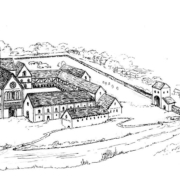
The Priory of St Neots
The foundation of the priory of St Neots is so involved in legend that it is almost impossible to separate what is true in it from what is merely the work of imagination. It may be that there was a monastery founded in this place before the period of Danish invasions in the 9th century; but of this there is no proof beyond the tradition recorded by Thomas of Ely. At any rate, the monastery known by the name of St. Neots Priory cannot be dated earlier than the reign of Edgar, under whose patronage so many religious houses were restored or built. The traditional date, between 972 and 975, would place this priory a little later than the abbey of Ramsey.
The founders are said to have been a certain earl Alric or Leofric, and his wife. Whether they founded the house in honour of the relics of St. Neot, which had fallen into their hands, as the chronicler declares, by an unexpected piece of good fortune, or whether they built their monastery first, and obtained the relics by some means afterwards, is a matter of little moment. The foundation was apparently made, like that of Ramsey, with the assistance of St. Oswald of Worcester, and the first monks were sent partly from Thorney and partly from Ely, being made subject to the latter house.
It is probable that the monastery was destroyed wholly or in part by the Danes in the later invasion of 1010; but it seems that a few monks lived on there till the Conquest. The manor of Eynesbury, in which St. Neots lay, belonged in 1086 to Roys, wife of Richard, son of Gilbert. Richard, her husband, it is said, expelled the English monks, and placed the house under the dominion of the Norman abbey of Bec. The first monks of the new foundation were sent by no less a person than St. Anselm himself, who had recently been elected to the chair left vacant by the appointment of Lanfranc to the see of Canterbury. The historian of Ely alleges that the three English monks, unable to accept the new régime, were sent across channel and placed in durance at Bec for the rest of their lives.
Some few years after the foundation of the new priory doubt was expressed whether the relics treasured in the shrine were really those of St. Neot. St. Anselm had the chest opened in his presence, and expressed his opinion that they were true relics. It would be interesting to know upon what token his verdict was based; the relics had had almost as chequered a history as those of St. Alban, and their character might well be considered doubtful.
Roys, wife of Richard, son of Gilbert, in her widowhood endowed the priory with more lands, and persuaded her children to follow her example. Her son Robert chose it for his burial-place; his wife, Maud de Senliz, gave the monks one-third of the manor of Cratefield, Norfolk; William d’Albini, son of Maud by a second marriage, King Malcolm and King William of Scotland, Henry Earl of Huntingdon, and Alan Dapifer, steward of Countess Roys, were all benefactors in the course of the 12th century.
Here, as elsewhere, there were suits on the subject of lands and churches in the 12th and 13th centuries. But the value of the priory seems to have decreased rather rapidly from this time, owing to the constant change of superiors. The earliest prior whose name is recorded, Martin, had been a man celebrated for his humility and holiness; so much so that when he was made abbot of Peterborough by Henry I without the consent of the convent, he soon earned the love and respect of his new subjects. Herbert, prior from 1159 to 1173, seems to have been mindful of the interests of the house under his charge; but after this there were constant changes, and the tone of the house was lowered, as in most of the alien priories. The abbot across the sea looked upon his English cells as merely a source of revenue; the alien priors knew they might be recalled at any time, and took no interest in the welfare of the house. During the 14th century, through the wars with France, the priory was constantly in the hands of the king’s escheators, and things went from bad to worse. Finally, in 1412, the priory was declared independent of Bec, on the ground that divine service was neglected and revenues diminished by maladministration. An English prior, Edward Salisbury, was placed in charge, under obedience to the diocesan, and the house entered upon a new career.
There had been early in the 14th century twelve to fifteen monks at St. Neots, but just before it was declared independent of Bec, all the French monks but two had gone home. It seems to have begun again with about twelve monks. Bishop Grey visited the house a few years after the denization, but his visitation may not have been very thorough. The injunctions are all formal, and show no bad signs; he ordered seats in the cloister, called carels, to be put up for the convenience of the monks in study, and two bells were to be hung, one in the cloister and one in the refectory. The condition of the priory at this time could not, however, have been very satisfactory, as in 1439, only a little later, Bishop Alnwick found a good deal that was amiss. The cloister and the church were both in bad repair, so that the rain came in on the choir books; the debts of the house were so serious that the monks were afraid to go out for fear of their creditors; the prior was neglectful of his office, and was accused of having obtained it by unfair means. The night office was not regularly said, and there was some suspicion of unchaste living.
The results of the visitation are not known, but the report of Bishop Smith in 1506 again implies a low standard. The accounts were not duly stated; deeds were sealed without the consent of the chapter; the brethren were not cheerful in their obedience, and they were not strict about wearing the habit of the order. Reform was ordered on all points, and the prior, having confessed his irregularities to the bishop in the chapter-house, was put to penance.
The commissioners who visited Ramsey and the neighbourhood in 1535-6 make no mention of St. Neots. They may perhaps have put out some monks professed under the age of twenty-five, according to their instructions; for as many as 11 signed the Acknowledgment of Supremacy, and only 7 surrendered with the prior in 1539. The value of the house was over £200, so it was not dissolved under the first Act, but lingered on till 21 December 1539, The prior then received a pension of £40, and his companions annuities varying from £7 to £6 6s. 8d. Five of them were still living in 1554.
The priory was endowed by Countess Roys with the whole manor of St. Neots, and the manor of Cratefield in Norfolk was given by other members of her family, with parcels of land and churches in the counties of Bedford, Cambridge, Suffolk and Northampton. The churches of St. Neots, Everton and Eynesbury in this county, Tempsford, Turvey, Edworth, Melchbourne in Bedfordshire, Barton Bendish, Beecham Well, Wimbish and Cratefield in Norfolk, Brampton Dingley and Hemington in Northamptonshire, Ubstone in Suffolk, Wing in Rutland, Cottesford in Oxfordshire, Pillerto in Warwickshire, East Boscombe and Cheldreton in Wiltshire, Ayot St. Peter in Hertfordshire, were all at one time in the possession of the priory. The churches of Melchbourne and Eynesbury were very early lost; the history of these and the others in relation to St. Neots has been so fully described by Gorham that it is not necessary to give any details here. The valuation of the temporal and spiritual property of the prior at the end of the 13th century was about £227: in 1535 it was £241 11s. 4½d., including the appropriate rectories of St. Neots, Everton, Hemington, Turvey, Upstone, Cratefield, and the manors of Crendon, Charlton, Barford, and Turvey in Bedfordshire, and Upstone in Suffolk. The first report of the Crown Bailiff gave a total of £256 15s. 8d.


 The Love’s Farm project represents a detailed archaeological examination of the later Prehistoric and Roman agricultural landscape on a previously unprecedented scale within the region. The site, located on heavy clay soils and adjacent to St Neots in Cambridgeshire, covered 60ha over half of which was stripped during the course of the excavations.
 Glacial melting pockmarked the surface of the western claylands with frequent shallow depressions. The preferred locations for the earliest settlers were such depressions on south-facing slopes, ideally those with an easterly aspect.
 Clay has certain advantages over other soil types if well managed. Not least amongst these are that groundwater is held within the subsoil/surface geology making the ground drought resistant.


 This feature stood out due to its prominent location on the crest of the slope, unusual layout and the striking arrangement of the radial ditch lines seemingly emanating from it. Its creation was part of a broader pattern of short-lived innovation or change that swept across the site in the 1st century AD.


 At the inquest later in the morning the prison surgeon testified that there had been fracture/dislocation of Horsford’s neck vertebrae.

