The history of biscuits

Munchable, scoffable, dunkable, WONDERFUL biscuits – few things in life are more pleasurable than a mug of tea and your favourite biccy.

It just so happens that the 29th May is officially National Biscuit Day! So, we thought we’d have a brief look at the history of these delicious treats. If you make it to the end of this without a craving for one, then your willpower truly is iron clad…

In the beginning…

House of the Baker, Pompeii

It turns out that biscuits, in some form or other, have been around for a really REALLY long time! The name ‘biscuit’ comes from the French ‘bis-qui’, but it’s Latin root ‘panis biscotus’ (meaning twice-cooked bread), tells us a variant of the treat has been around since at least the Roman period.

The biscuit the Romans had is closer to a ‘rusk’, the sort that babies today now enjoy, and was basically bread which had been baked again to make it crispy. In this form, the bread kept for longer and was often used as a snack for those ‘on the go’ or as part of a centurion’s’ rations. Jumping ahead of ourselves here, we see biscuits being used in this way much later in the 18th, 19th and even 20th centuries too as part of ships’ rations. Unable to maintain a constant supply of fresh food, naval boats would carry huge supplies of ‘ship’s biscuits’ or ‘hardtacks’, biscuits so tough they were famous for being indestructible. Unsurprising then, that the earliest surviving example we have of a biscuit from 1784, is one such biscuit!

Medieval and Tudor treats

‘Biscuit’ came to use in English from around the 14th century, and variations on the theme started to appear. Varieties closer in form to pancakes were also becoming more common. Wafer biscuits started to emerge and grew in popularity, these were made of a sweetened batter and cooked over a fire. The famous ‘Jumble Biscuit’ also appeared in the Medieval period, traditionally shaped in a knot pattern and flavoured with much prized spices like caraway, aniseed and mace.

By the Tudor period gingerbread had started to appear. Containing sugar and expensive spices, it was only for the rich (and those who weren’t too bothered about their teeth!) The gingerbread was often coloured and moulded into intricate shapes and structures. The first ‘gingerbread-men’ are often attributed to court of Queen Elizabeth I, where biscuits were made in the likeness of important guests. Fancy!

The darker side to our sugar craving

Biscuits started to become more accessible to the masses in the 17th century due to the colonisation of the West Indies and Americas, and the rise of the slave trade. This dark and shameful chapter of our history caused the price of sugar to fall dramatically, which in turn sparked new developments in the types of biscuits and cakes on the market. Chocolate, coffee and tea were also introduced to Britain at this time, and were soon to become the popular partners to biscuits. Until the 18th century, biscuits had mainly been eaten as a dessert, but as drinking tea became rooted in our society, biscuits became tea’s ideal accompaniment.

A biscuit revolution

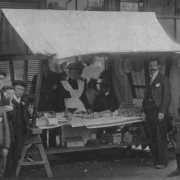
Biscuit and cake stall, St Neots Market, c. 1900

By the 19th century, biscuits had really taken off, and the varieties available had increased substantially. The Industrial Revolution allowed biscuits to be produced on mass, and changes to the working day caused breakfast to be eaten earlier and dinner later, leading to an increase in the need for an afternoon snack! Big names such as Peak Freans started the production of Garibaldis in 1861, and Bourbon biscuits in 1910.  Digestive biscuits were developed by Huntley & Palmers in 1860, and marketed as, you guessed it, an aid for digestion.  In 1892 McVities made the first Rich Tea biscuit, and followed it up with the Chocolate Digestive in 1899. Many biscuit companies produced special tins of their biscuits, which quickly became the new must have collectable items.

Plum’s Cake Shop & Cafe St Neots, c. 1920s

And today…

Today, the biscuit industry is worth over £3 billion and recent studies have shown that 99 in every 100 UK households buy biscuits. From the humble Digestive, to the dunkable Hobnob, to the flamboyant Party Ring, it’s fair to say our love of biscuits shows little sign of diminishing.

So, which is your favourite?…


The history of English gardens

Here’s a fascinating guest post by one of our volunteers, Emily, who’s here to enlighten us all about the history of our beloved gardens…

Gardens, we all take them for granted these days don’t we? Whether it’s a little plot at the back of your house, or a ginormous plot of land belonging to a large estate, the garden is a place where we can retreat and where nature can thrive. But have you ever thought about the origins of our gardens, and how they evolved over the centuries? Well, if you are sitting comfortably, then I’ll begin…

Tudor garden twists

A Tudor maze design

Gardens in the past changed with what was fashionable at the time. If you didn’t have the latest garden trend, then you were nobody. In the early days of the Tudor period, gardens were, like today, places to socialise and to take exercise. In those days, when practising the wrong religion could get you into BIG trouble, rich landowners would hide religious symbols within their gardens, as well their houses. A maze was often a feature in these gardens, and guest could enjoy them often oblivious to the notion that they may be a religious symbol. Instead what they saw was perhaps a form of entertainment, especially when catch a dashing suitors’ attention was part of the fun!

By the time of the Stuarts, some considered the style and symbols of the old Tudor gardens, ahem, out of date, and had them redesigned to meet the fashionable standards of the time. Trees and paths were the order of the day! Oh there were flowers too, but planted in straight lines. The English were very keen to stay ahead of their rivals, the French, and it was very much a case of “anything you can do, we can do better ”. So English gardens became very French in style, in an attempt to out do them. An example of this is the famous garden at Hampton Court. A garden for royalty and the well to do, designed for walks and parties. A bit like today really!

The illusion of untamed nature

Fast forward to the Age of Enlightenment and the gardens of the stately home changed dramatically. Out went the formality and in came the ‘nature-controlled’ gardens, ones created by man, but with the illusion that they were perfectly natural. We see this most in the gardens of the stately homes we know and visit today, from Stowe in Buckinghamshire to Castle Howard in Yorkshire. Like the Tudor gardens, these could also have hidden meanings. From the political views of the owner, to telling stories according to folklore and fairy tale, the garden became a place for the well-to-do to play out their fantasies.

Cambridge Botanical Gardens – Photo copyright Emily Fleming 2020

These gardens didn’t come cheap though, if you were hoping to build a grotto for your back garden for a small sum, you’d need to think again! One man responsible for making these gardens a reality was Lancelot “Capability” Brown – THE man for job. The prices attached to his gardens were eye-wateringly expensive, particularly as everything was done by hand, no JCBs here! Planning a visit to your local garden centre to buy things off the shelf wasn’t an option, and much of it, like the statues, had to be sculpted from scratch.

BUT if you DID have the cash, then you could have everything you could possibly want. Waterfalls, temples, grottos, you name it. The temples and ruins that were constructed for these gardens were often Grand Tour inspired. These trips or ‘tours’ were taken by the aristocracy to places like Greece and Italy, and from them, they bought back classical ideas for their gardens. It was the time of ‘the Romantics’, romanticising the ancient histories of Rome & Greece. It’s something we still do today, we all like a bit history in our gardens…

Kitchen gardens

In the Georgian and Victorian periods, the garden changed again, with clashing colours mixing in the borders, and the introduction of greenhouses for growing plants and produce normally grown in a warmer climates, like ferns and palm trees! Growing fruit and veg in the garden had of course been around for some time, with many stately homes having their own kitchen gardens built for the purpose. Back in the Georgian period, the way to show off your wealth was to have a ‘pinery’ for growing, wait for it, pineapples! Why were they a symbol of wealth you ask? Because pineapples are notoriously temperamental and an absolute pain to grow!

The humble back garden

Photo copyright Emily Fleming 2020

By the Victorian era, the garden started to become more accessible to the masses, and those who were lucky enough to have their own back garden for their property, used them primarily to grow produce for their families. Gardens became more functional places over spaces to socialise. During WW1 and WW2 the kitchen garden was considered more important than ever before, growing whatever was needed to survive.

Today, many gardens combine the role of food provider and leisure space, taking snippets of inspiration from gardens throughout history and all over the world.  Whether they are well loved and cared for or messy, neglected and in need of a little love, they’re something that we all recognise and take pleasure from. The fashions and designs of gardens will change, but the need and desire for them will always remain the same.


Unfortunate royal epithets

Ever wondered about the stories behind historical monarchs’ epithets? Here’s 10 royals from the past who gained some rather unfortunate nicknames…

It’s tradition for monarchs the world over to gain a few additional names, both during and after their reigns. For some, these might be good or heroic e.g. William the Conqueror or Elizabeth Gloriana; for others they might be more mundane. Both Henry I and Henry II, who granted important privileges to St Neots priory in the 12thC, had epithets of a less exciting nature (Henry I was known as ‘Beauclerc’, the French for ‘Good Clerk’, and Henry II gained the name ‘Curtmantle’, Middle English for ‘short cloak’).

Unfortunately for a large number of royals, the nicknames associated with them are of a more, shall we say, unflattering tone. We’ve picked our top 10 below, revealing the story behind the name…

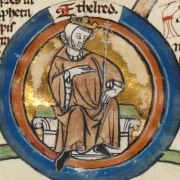
Ethelred the Unready

Two Anglo-Saxon silver pennies of Aethelred held by the museum

Let’s start with a famous one! Ethelred (or Aethelred) the Unready, was king of the England from 978-1013CE and again from 1014-1016CE. He is famous for being an incompetent ruler, who failed to prevent the Vikings from overrunning England. He first attempted to buy his way to peace, but when this failed, he launched attacks on the Danish settlers, only provoking further invasions! The epithet ‘unready’ is derived from ‘unraed’, which actually means ‘bad counsel’ or ‘no council’. The nickname is in fact a twist on his name which rather comically means ‘noble counsel’.

Ivar the Boneless

Ivar the Boneless was a Viking leader who invaded Anglo-Saxon England in the 9thC, becoming ruler of York. The origin of the nickname is up for debate; several of the Viking sagas alarmingly describe him as lacking legs or bones, whilst in the ‘Tale of Ragnar’s Sons’, it’s suggested that his name is in fact figurative, and refers to male impotence!

According to the ‘Tale of Ragnar Lodbrok’ (Ivar’s father), his bonelessness was the result of a curse. His mother Aslaug, a seeress, prophesied that she and Ragnar needed to wait three nights before consummating their marriage. But Ragnar, overcome with lust after a long separation whilst raiding England, ignored this advice. As a result, Ivar was born with weak bones.

Ivaylo the Cabbage

Slightly more surreal in the name-game is Ivaylo of Bulgaria. Ivaylo is remembered as a strong military leader, spearheading numerous peasant uprisings before climbing up the social ranks and eventually becoming emperor. His nickname ‘the cabbage’ or ‘lettuce’ was given to him to reflect his low social origin. Charming!

Louis the Unavoidable

Poor old Louis XVIII of France spent much of his reign in the late 18thC in exile due to the French Revolution of 1789-1799. When things began to stabilise once again at the turn of the 19thC, and Napoleon was finally defeated in 1815, Louis was deemed the ‘unavoidable’ choice to return and reclaim the throne. Talk about a blow to his self-esteem!

Joanna the Mad

The impact of a grief filled life earned poor Joanna of Castile this unfortunate name. Big sis to Catherine of Aragon, and sister-in-law to Henry VIII, Joanna was also married to Philip ‘the handsome’ of Spain (lucky her!) In her early life she was an intelligent and well-educated young woman, with numerous languages under her belt. However, after the deaths of numerous family members, she suffered from long bouts of insomnia and poor appetite, and was often known to fly into a rage when prevented from exercising her will.

But the act that really sealed her as ‘mad’ in the minds of the people, happened when her husband died in 1506. Joanna refused to part with her husband’s body for a disturbingly long time. Though she was heavily pregnant, she travelled with his body from Burgos to Granada (just shy of 670 kilometres!), where he was to be buried. She was said to have often opened her husband’s casket on route, to embrace him. Eep!

Charles the Mad

Staying along the same lines, the French King Charles VI was known to have suffered from multiple spells of real insanity during his life time. We’re told that at times he couldn’t remember who he was, nor did he recognise his wife or children. He would often ‘run wildly’ through the corridors of his palace, compelling his staff to have entrances walled up to prevent him from escaping! The thing that Charles is most famous for, however, was the belief that he was made of glass and could shatter at any time, he even had iron rods sewn into his clothes to stop himself from breaking…

Bloody Queen Mary

Mary I of England spent only five years on the throne, but during that time she gained quite a reputation for herself. She is famous for her persecution of her protestant subjects, burning them at the stake (the preferred method of execution by the notorious Spanish Inquisition) in an effort to return the country to Catholicism. In actual fact, she was responsible for far fewer deaths than her father Henry VIII, but later propaganda during her protestant sister Elizabeth I’s reign, muddied her name and magnified her acts of oppression.

Mary had been married to Phillip II Spain, who had attempted to use the union to exercise his own influence over England. After Mary’s death, Philip sent a fleet of ships (the famous Spanish Armada) in an attempt to take control, but was defeated by the English navy. Mary was seen as the catalyst for this renewed threat from Spain and was therefore blamed for the whole sorry matter. That bloody Queen Mary, eh?

Louis the Spider

This one depends on how you feel about spiders really… King Louis XI of France had a love of plotting and intrigue, he had a history of planning and participating in conspiracy, even against his own father Charles VII. After he ascended to the kingship in 1461, his love of scheming continued, he had a network of royal postal roads developed, with messengers at his constant disposal to aid in his intrigues. He earned the names ‘Cunning’ and the ‘Universal Spider’ due to these communication ‘webs’, along with the webs of conspiracy he would spin around Europe.

Harald the Lousy

Sticking with the creepy-crawly theme… Harald Harfagre was the first King of Norway in the 9thC. His byname, ‘Harfagre’ actually means ‘fair haired’ or ‘beautiful haired’, but according to historical sources this wasn’t always the case…

Legend tells us that Harald had previously vowed not to cut his hair until he was the king of Norway. By the time he actually received the crown a decade later, his hair was understandably in quite a state, and home to a fair few skin-itching hitchhikers! It’s no wonder he chose to re-brand after becoming king…

Charles ‘the Bad’ of Navarre

What better place to end than downright bad? Charles’ career was littered with rebellion and assassinations as he fought to gain power from John II, King of France. In his attempt to gain the crown, he even allied himself with the English King Edward III, the ultimate betrayal! But the act that really earnt him the title ‘bad’ was his involvement in the ruthless suppression of the Jacquerie (French peasant) revolt in 1358, where men were slaughtered in their thousands.

Charles was to get his comeuppance however, and his horrific death in 1387 became famous throughout Europe as a divine justice. After Charles became ill, his doctor ordered him to be wrapped head-to-toe in brandy-soaked cloths. When the nurse administering the wrapping had finished, instead of using scissors to cut off the excess fabric, she used a candle to burn off the end. And you can guess what happened next…

Charles the Bad and John the Good
St Neots VE Day celebrations

On Friday 8th May, the whole of Europe had intended to commemorate the end of World War II with VE and VJ Day events.

The events were to mark the 75th anniversary of the original Victory in Europe and Victory in Japan days, held in May and August 1945. While the planned celebrations are sadly no longer possible, we can all still privately and virtually commemorate the millions who died too soon, and all those whose lives were changed forever by the catastrophic events of the Second World War.

An end to war

On the 8th & 9th May 1945, after over five long years of war, the entire population of Europe came together to celebrate the end of the fighting on the continent. Though nations still mourned all those who had died or been injured or traumatised, and continued to wait for the end of the war in the east (where the war with Japan was still continuing), the end of fighting in Europe was a reason to celebrate.

St Neots celebrates

The local newspaper, the ‘St Neots Advertiser’, reported details of the many celebrations that took place in the town and the surrounding villages.  Reports read:

“St Neots received the joyful news of the end of the war against Germany quite calmly, with feelings of thankfulness to God; happiness; relief; pride; humility; gratitude to the gallant men and women who made victory possible; remembrance of those who had given their lives for us in many parts of the world; sympathy for their relatives; and a vivid reminder of the stern fight ahead against the brutal Japanese.”

‘Salute the Soldier’ parade, Sandy 1944

“An outward sign of rejoicing was a profuse display of flags…Russell Street was a specially high spot. Church bells rang merrily in St Neots, Eynesbury and Eaton Socon”

The re-formed Eynesbury and St Neots Town Silver Prize band paraded the town and played on the Market Square. Church services were held throughout the day and the paper reported “joyous scenes on St Neots Market Square on VE night”. Loud speakers had been installed on the square and dancing to popular tunes continued in to the early hours.

The paper believed that local lady, Miss Dorothy Wrycroft, was chiefly to be thanked for arranging the dancing, along with Maypole dances for children. Victory Day coincided with St Neots May Fair (which opened on Thursday 10th May), and Thurston’s, the fair owners, allowed the public to use the motor track of one of their large roundabouts for dancing on the Market Square.

Dorothy Wrycroft

At 9pm a hush fell as the “immense crowd” listened to the speech by H.M. King, George VI, which was later printed in local papers. In part of his speech, he spoke for the whole nation when he said:

“Let us remember those who will not come back; their constancy and courage in battle, their sacrifice and endurance in the face of a merciless enemy: let us remember the men in all the services, and the women in all the services, who have laid down their lives. We have come to the end of our tribulations, and they are not with us at the moment of our rejoicing.”  

An end to restrictions

After five long years of night time black-out restrictions, another hugely popular part of the celebrations was the lighting of bonfires, and on many of them, the burning of a hastily created effigy of Hitler. Lights in the darkness must have been a particular pleasure after the black-out, and locally, Little Barford power station was floodlit and could be seen for many miles around. Many other buildings were also floodlit in celebration of the end of the war.

Local celebrations

St Neots police station, ‘Air Raid Precautions HQ’ 1939 – 1942

In the villages around St Neots, each community came together to celebrate. In Eaton Socon, the highlight of VE Day itself was the huge bonfire at the Hillings, where Hitler’s effigy was duly consumed by the flames. Fireworks were let off on the Green, where the dancing continued until 2 a.m.  Another bonfire was lit on the Fair Ground at Eaton Ford, where the large crowd that had gathered witnessed another cremation of Hitler.

Even the Inmates of the St Neots Institution had extra rations, and those who were well enough were allowed to attend local church services and the jollifications.

At Little Barford, the whole village assembled at Little Barford House at 1pm by invitation of Mr W H Alington, where a short address and a toast were made.  After an evening Service of Thanksgiving, a bonfire was lit and a great centre of interest was a life-size, and remarkably life-like, effigy of Hitler found hanging from a tree.

In Great Gransden, the St Neots Advertiser reported that:

“Hundreds of people assembled in the Cricket Field in the afternoon to hear Mr. Churchill’s broadcast of the end of war in Europe…In the evening it was estimated over 1,000 people were on the field where an open-air dance was held.”

In Waresley, the village was gaily decorated, a dance took place on the Tuesday evening, and on the Wednesday tea and sports were held in Mr. A. Minney’s meadow.

Throughout the celebrations there was little rowdy behaviour, although the police were kept busy preventing some celebrations from getting out of hand.

Festivities for children

Russell Street VE Day celebrations, St Neots

If Tuesday the 8th May was a day for adult celebrations, then Wednesday 9th May was, in many places, given over to parties and sports events for children and young people.  Both women and men put all their energies into entertaining the children and making it a memorable day for them.

In St Neots and Eynesbury, many parties were held in the decorated streets, on the greens, and in halls and barns.  The women organisers of the parties made a wonderfully good job of it at very short notice; not only did they collect money, beg or bake dainty food for sumptuous repasts, cut sandwiches, make jellies, officiate as waiters (in gay hats and costumes), clear away AND do the washing up, but they helped to decorate their children for fancy dress parades. Meanwhile, the men folk gave a willing hand, fixing up tables and, on the Wednesday, arranging sports and games in recreation grounds and fields across the area.
Service men and women return home

In the newspapers, under the heading “News of our Soldiers, Sailors and Airmen”, appeared reports of those who were returning home after being held as Prisoners of War.

Perhaps the happiest people in Eaton Socon on VE Day were Mr and Mrs G Eckford.  They had received no news of their son, George, who had been taken prisoner at Tobruk just over three years prior, and had been held in camps in Italy and Germany.  Tuesday 8th May brought the telegram they were waiting for which said that he was ‘safe and well’.  This good news meant that all the Eaton men who were prisoners in Germany were accounted for, some were even home with their families in time for VE Day.  This included Flight Sergeant Aubrey Waters, son of Inspector Waters of St Neots.  His plane had been brought down over Germany on 16th March the previous year; he had baled out safely and landed in a back garden in Stuttgart, where he was captured by the German civil police.  It had been only his third ‘op’ after taking the place of a sick gunner from another crew.  His original crew were shot down some three weeks later.  During his time as a prisoner, he had been in a number of camps, and had suffered close to starvation on the long marches between them.  He later said, however, that boredom had been his greatest enemy.

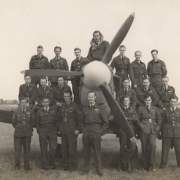
A group of servicemen including Spitfire pilot Victor Ekins of New Street, St Neots

Also home was Private Horace Coe from Bedford Street.  He had endured three and a half years as a prisoner im Sicily, Italy and Germany, having been captured while serving with the 1st Armoured Division in the African Desert.  His greatest ordeal was having to march 800 miles with few, or no, rations following the D-Day break through.

Petty Officer Graham Ibbs gave his parents a surprise by walking into their home at The Crescent unexpectedly.  In June 1942 he’d been serving with the destroyer Bedouin when it was torpedoed while on convoy escort to Malta.  He was picked up by an Italian Red Cross boat and imprisoned in Italy.  On the capitulation of Italy, Petty Officer Ibbs escaped, and actually reached the Swiss border before being recaptured by German troops.  He was then sent to Bremen where he remained until the camp was liberated by the Allies.

These three reports illustrate just a few of the many stories of hardship being told by the returning Prisoners of War. In marking the 75th anniversaries of both VE & VJ Days, we recall and commemorate the sacrifices and the hardships experienced by the people of Britain and the global population during the 1939 – 1945 war.

Looking to share your own family memories?

The Museum is still looking for photographs and memories of St Neots and the surrounding villages from 1939 – 45, so if you have any information please do get in touch. We can scan and return photographs, so precious family items do not need to be donated to the museum. As we are currently closed, you can get in touch by emailing us at director@stneotsmuseum.org.uk.

Famous surprise attacks from history

We all know the tale of the Greeks sneaking into Troy in the belly of a giant wooden horse, so we thought we’d share three other surprise attacks from history that you may not have heard of…

Hannibal and his alpine elephants

In 218BC, the Carthaginian army (led by the notorious general Hannibal) made a bold move that no one expected. Driven by his ambition to conquer Rome, Hannibal marched his entire army, including cavalry and WAR ELEPHANTS, through Gaul and across the Alps to strike at Rome from the north. The Romans, having naturally presumed that the Alps were a good enough defence against northern invasions, hadn’t anticipated this and were caught on the back foot.

It wasn’t an easy journey for Hannibal, many of his troops and cavalry perished on the perilous mountain passes, but eventually he made it. Hannibal fought his way down through Italy, ravaging the land and attacking its citizens for a full 15 years, but was ultimately unable to conquer Rome itself. He finally met his match against Roman general Scipio Africanus in 202BC, who put an end to Hannibal’s ruthless campaign.

A decoy rebellion

Staying on the subject of ancient Rome… In 9AD, three entire Roman legions met their end when they were surprised by a ‘barbarian’ army whilst campaigning through Germany. Around 36,000 Roman soldiers were led into an ambush by a Germanic warlord named Arminius, who craftily spread rumours of a fake rebellion in the north-west of the country. Spurred on by the threat, Roman general Publius Quinctilius Varus marched the 17th, 18th and 19th Legions from their camp to Teutoburg Forrest to face the phoney rebellion. BUT the Germanic army was waiting for them on route, ambushing them and slaughtering up to 20,000 Roman troops. It’s said that Emperor Augustus was so enraged by the news that he head-butted the walls of his palace! As for the legions, the 17th & 19th were disbanded and never used again.

Harold in a hurry

In 1066AD, it was the turn of Anglo-Saxon King Harold Godwinson to mount a successful surprise attack on a Viking army at Stamford Bridge. Harold’s forces had been positioned in the south ready to repel an expected attack by William of Normandy, but this was about to change. News arrived that 300 Norse ships had landed an army further north, so Harold quickly abandoned his post and raced up to meet them, covering nearly 200 miles in four days! When Harold’s army arrived at the edge of the Viking encampment, the Norse raiders were caught completely unawares. They’d wrongly assumed that Harold’s army would still be miles away and were kicking back before their raids really began. Harold’s army sprang into action, killing thousands of Vikings in the ensuing fight. The few survivors later sailed home aboard just 24 ships of the original 300.

Sadly for Harold, his success wasn’t long lived. Three days later, the army he HAD been expecting finally did show up. Shortly after Harold raced back down to meet the new threat, he was killed in the famous Battle of Hasting, his death now immortalised on the famous Bayeux Tapestry.

City foundation myths of the ancient world

They say that Rome wasn’t built in a day, but legend tells us that it WAS founded on one…

The 21st April 753 BC was just like any other day (well, we imagine) until two famous brothers had a fall out. The result was the creation of Rome, one of the powerhouses of the ancient world. Though the story of Rome’s origins is rooted in myth, we still acknowledge its foundation on this day. So, to mark its anniversary, here’s the myth of Romulus and Remus, along with a few other city foundation myths from the ancient (and not so ancient) world.

The foundation of Rome – Romulus and Remus

The twin brothers Romulus and Remus, were supposedly the sons of Mars, god of War, and Rhea Silvia, daughter of the king of Alba Longa and a revered ‘Vestal Virgin’ (or priestess, sworn to chastity in honour of the goddess Vesta). Poor Rhea Silvia hadn’t become a Vestal Virgin by choice, but had been forced into it by her uncle Amulius after he deposed her father, killing off his male children in the process.

When Amulius discovered that Rhea Silvia had broken her vow of chastity (though how much say she had in the matter is questionable where Roman gods are concerned), and given birth to two boys, he was understandably cross. He charged his servants to set the boys adrift in a basket on the River Tiber, rather optimistically assuming that would be the end of the matter!

La Lupa

Instead of meeting the watery death intended though, the brothers floated down the river and were discovered by a she-wolf, who suckled the twins, keeping them alive until they were taken in by a shepherd and his wife. The pair grew up, and decided that as a thank you, they’d found a city on the site where the she-wolf discovered them. Nice!

A city is born

However, the nicety of the gesture was short lived. After a quarrel about which hill was best to build the city on, Romulus killed his brother, and founded Rome in his own name to celebrate. Talk about brotherly love. Sadly, Romulus’ dishonourable actions didn’t stop there, in order to populate the city, he stole women from the nearby region of Sabinum – a scene now immortalised in numerous pieces of Renaissance art as ‘The Rape of the Sabines.’

Under his leadership, Rome was to go on to become the dominant power in the region. We’re told that eventually Romulus himself disappeared in mysterious circumstances during a violent thunderstorm. Spooky…

Athens – Athena vs. Poseidon

Athens, the city at the heart of the Greek civilisation was also founded by a contesting pair. Both Athena, goddess of wisdom, and Poseidon god of the sea competed for the honour of becoming the patron god of the city, and offered gifts for judgement by its citizens.

First Poseidon struck the ground with his trident and created a spring, offering water to drink and indicating that he could offer great naval power to the city. The inhabitants rushed forward to drink but were shocked to find that it was (naturally) salt water! Athena, on the other hand, offered the first olive tree, a symbol of prosperity and peace, along with the promise of food, oil, and firewood.  The citizens decided that on balance, Athena’s gift was the most promising, and the city has taken her name ever since.

N.B. Depending on the version of the myth that you read, Poseidon proves to be a very sore loser and floods the city in revenge.

Alexandria – Alexander’s dream

After conquering vast swathes of the ancient world, Alexander the Great decided it was about time that he founded his own city to help assert his dominance (and further inflate his ego).

On the advice of his architects, Alexander had already settled on a good spot to build his city, until, during a dream, he saw a vision. An old man with white hair and an esteemed appearance came to him and said: “There is an island in a stormy sea in front of Egypt. They call it Pharos.” *FIN*… Who this man was remains about as unclear as his message. Some say it was the Greek historian Homer (of whom Alexander was a huge fan), but whoever it was, Alexander jumped straight to the conclusion that THIS was where he should build his city.

No chalk, no problem

He travelled to Pharos (an island above the mouth of the Nile in Egypt), and on arrival discovered that it was THE perfect spot. Shortly after, he set to work laying out the outline of the city. Annoyingly, he didn’t have any chalk to hand, and so he used barley instead. As you do.

When he finished, he sat back to admire his work, but suddenly a huge flock of birds flew from the river and ate the whole thing, every last grain. Alexander was understandably pretty miffed about that, but his quick-thinking seers hurriedly advised him that ACTUALLY, this was a good sign. In their view, what it meant that the city he was founding would ‘abound in resources and would sustain men from every nation.’ Alexander shrugged, thought “fair enough”, and a city was born.

Tenochtitlan – An eagle in a (prickly) pear tree

The tribes who were soon to be known as the famous ‘Aztecs’ received some rather peculiar orders from their god Huitzilopochtli, the god of sun and war.  Huitzilopochtli instructed them to abandon their home-land and start a pilgrimage to find a new one, where they would become the most powerful race in Mesoamerica. He told them that they would know once they’d found the place if they spotted an eagle, perched on a prickly pear cactus, oh and it would also be devouring a snake.

The precise spot turned out to be rooted in the heart of rebel god Copil, Huitzilopochtli’s nephew, who had been killed after his latest failed uprising attempt. As further punishment, his heart had been carelessly thrown into the centre of a lake.

The Aztecs located the spot in the centre of Lake Texcoco, and named the city after tetl meaning rock, and nochtli, the prickly-pear cactus.


Winner of Cambridgeshire Small Museum of the Year

This year the Museums in Cambridgeshire organisation have launched an Awards scheme for museums in Cambridgeshire and Peterborough, with five award categories open to all museums in the area.

St Neots Museum are delighted to announce that at the Awards Ceremony, held at the Museum of Zoology, Cambridge, on Monday 4th November they received two Highly Commended awards and won the Small Museum of the Year award, for museums with up to 10,000 visitors per annum.

Our two highly commended awards were, firstly to our hardworking documentation volunteer, Jean Stratford who was Highly Commended in the Heritage Heroes category and secondly for our Jailbreak Escape Room project, run jointly with Simon and Jenny Cooper of ‘Mystery in History’ which was Highly Commended in the ‘New for You’ category.

The judges included regional museum professionals as well as a ‘mystery visitor’ who paid an unanounced visit to the museum to see how we measured up in real life! In awarding St Neots Museum the Cambridgeshire Small Museum of the Year Award the judges said of the museum:

The museum team have worked tirelessly to improve every area of museum operation, generating new income streams in the process. They’ve developed effective new partnerships, become more involved in setting local priorities and have made welcome the many new communities springing up on their doorstep. This incredible team monitor and evaluate their work, feeding lessons and recommendations from professional advisors into their planning for the future. Although limited in capacity, their achievements over the past year make them truly deserving of the title ‘Museum of the Year’.

Liz Davies, Curator and Lesley Sainsbury, Learning and Development Officer said:

We are absolutely thrilled to have won this award which is recognition of the hard work of all the museums dedicated volunteers, Trustees and Management Committee and of our many other supporters in the community from artists to business people who contribute to our success in so many ways – without them we could not have achieved this award

The Battle of St Neots

battle of st neots

On Sunday, 9 July 1648, seven months prior to the execution of King Charles, the Earl and his army of approximately 400 men entered St Neots in the county of Huntingdonshire. The Earl’s men were hungry and weary, following their escape from Kingston upon Thames, where the Parliamentary forces had completely overwhelmed them. Of his original army of 500, the Earl escaped with around 100 horsemen and were immediately followed by a small party of Puritan and Parliamentary horsemen. After much hesitation regarding in which direction they should flee, the Earl decided on Northampton, and the group made their way via St Albans and Dunstable. Upon the outskirts of Bedford the group turned eastward towards St Neots town. At Kingston, the Earl was joined by the young Duke of Buckingham, his young brother Francis Villiers and the Earl of Peterborough. They were also joined by Colonel John Dalbier, an experienced German soldier who was hated by the Roundheads, having previously served with them under the 3rd Earl of Essex until taking up arms in favour of the Cavaliers’ cause.

The field officers of Holland’s force sought only rest and safety. Colonel Dalbier called a council of war, where many officers voted for dispersing into the surrounding countryside. Others suggested they should continue northwards. Colonel Dalbier advised on the strategic position of St Neots and the fact that the joint remnants of Buckingham and Holland’s forces had increased sufficiently since the retreat from the Roundheads at Kingston. He suggested they meet and engage their pursuers. He further added that, by obtaining a victory, the fortunes of war could be turned in their favour. Due to his vast experience as a soldier, his words were listened to with respect. He further offered to guard them through the night in case of a surprise attack, or meet a soldier’s death in the defence of the town. A vote was taken and Dalbier’s plan was adopted.

The Earl of Holland — who, it was said, “had better faculty at public address than he had with a sword” — joined Buckingham and Peterborough in addressing the principal residents and townsfolk of St Neots. The Duke of Buckingham spoke at length, claiming “they did not wish to continue a bloody war, but wanted only a settled government under Royal King Charles.” Assurances were also given that their Royalist troop would not riot or damage the townfolks’ property. Of the latter, it is recorded that they were faithful to their promise.

Fatigued by their battle and consequent retreat from Kingston, the field officers eagerly sought rest. True to his word, Colonel Dalbier kept watch over them. The small group of Puritan horsemen who had pursued them had, upon reaching Hertford, met with Colonel Scroope and his Roundhead troops from their detachment at Colchester.

At two o’clock on Monday morning, 10 July, 100 dragoons from the Parliament forces arrived ahead of the main army at Eaton Ford. Dalbier was at once informed, and immediately gave the alarm: “To horse, to horse!” The dragoons, equipped with musket and sword, crossed St Neots’ bridge before the Royalists were fully prepared. The Battle of St Neots had begun.

The few Royalists guarding the bridge quickly fell back from the superior numbers before them. The ensuing battle was now fought on the main square and streets of the town. The remaining Royalists were now fully prepared for combat. The main army of Roundheads had also arrived, and a further wave of Puritans crossed the bridge into town. The battle was fierce, with the Puritans gaining ground.

Colonel Dalbier died during the early stages of the battle. Other prominent Royalists, including Buckingham’s younger brother Francis Villiers, and Kenelm Digby (son of the scientific writer of the same name), were also killed during the battle. Other officers and men drowned whilst attempting to escape by crossing the River Ouse. The young Duke of Buckingham, being overwhelmed by the speed of these events, escaped with 60 horsemen to Huntingdon, with the intention of continuing towards Lincolnshire. Upon realising the Roundheads were in hot pursuit, he changed plans, and via an evasive route returned to London from where he later escaped to France.

The Earl of Holland with his personal guard fought their way to the inn at which he had stayed the previous night. The gates had been closed and locked, but were quickly opened to admit him, and immediately closed again as he entered. The Parliamentarians soon battered them down and entered the inn. The door of the Earl’s room was burst open to reveal him facing them, sword in hand. It is recorded that he offered surrender of himself, his army and the town of St Neots, on condition that his life was spared.

The Puritans seized the Earl and took him before Colonel Scroope, who ordered him to be shackled and imprisoned under guard. The remaining Royalist prisoners were locked in St Neots parish church overnight, then taken to Hitchin the following morning. The Earl and five other field officers were taken to Warwick Castle, which had remained a parliamentary stronghold throughout the war. They remained prisoners for the next six months, until their trial for high treason. In London it was said “His Lordship may spend time as well as he can and have leisure to repent his juvenile folly.”

Peterborough also escaped disguised as a gentleman merchant, but was later recognised and arrested. Friends aided their escape again whilst en route to London for trial. He then stayed at various safe houses, financed by his mother, until he managed to flee the country.

This text has been reproduced from wikipedia under Creative Commons licence.

Wintringham Park archaeological survey

In November the museum curator was lucky enough to be part of a group that visited the archaeological dig going on opposite Loves Farm in preparation for the Wintringham Farm housing development.

Many thanks to Don Hill from the St Neots Local History Society for organising the visit and Project Manager Tom Phillips andProject Officer Pat Moan, both from Oxford Archaeology East for showing us around the site.

The excavations have revealed evidence of several Iron Age period (400 to 100BC) round houses. They often leave little evidence in the ground where they once stood but the shallow ditch that can just be seen in this photograph, shows where rainwater ran off the thatched roof of the house.

The Iron Age families who lived on the site 2,000 years ago were farmers who grew cereal crops and kept cows, sheep and pigs, and the archaeologists have found evidence of tracks and field boundaries from the Iron Age period, similar, and in some cases linked to, the tracks and boundaries that they found were the Loves farm development now stands.

The photograph above shows the excavated remains of a pond that was dug, during the Iron Age, among the fields to provide drinking water for farm animals. The sloping pathway to the pond was cobbled to allow easier access for the animals.

Fragments of Iron Age pottery have also been discovered and it is fascinating to think of the people who used the pottery and lived on the site over 2,000 years ago. This is only the first phase of archaeological excavations on the site and if there are going to be open days and site tours there will be plenty of publicity to let everyone know.

The story of Ann Izzard

Ann Izzard was accused of witchcraft by her fellow village folk in 1808. This is a tale of how unfortunate circumstances can lead to fear and exile from one’s own community…

A brief look at her early life

Ann Izzard (born Ann Rowe at Offord in 1765) worked as a live-in servant for John Jackson, a farmer at Great Paxton, in 1778. It was while she was employed there that she met Wright Izzard and the pair began a relationship. Shortly afterwards, perhaps due to this relationship, Wright lost hist job on the farm, and records show that Ann and Wright were quickly married in Great Paxton on 21st November 1780, before moving to Great Staughton where their first child, Henry, was born.

By 1783, both Ann and Wright appear to have been unemployed and applied for parish relief, the unemployment benefit of its time. This was always paid from your ‘home’ parish and local parish officials would go to great lengths to ‘move on’ anyone for whom they thought another parish had responsibility. For this reason the couple were made to return to Great Paxton where the authorities housed them in a small, empty cottage away from the main village. Here they lived for many years, claiming parish relief and raising at least six children.

Whispers of witchcraft

This means of existence continued for the family until 1808, when the payments ended after one of their children, Miles, found employment for a local farmer. With no parish relief income, it’s likely that the family became very poor, and it may be that stories of Ann begging for food date from this period. It was certainly around this time that rumours that Ann was a witch began to circulate…

In April 1808, Ann was accused by villagers of bewitching their children, and causing them to fall ill with fits. The parents of Alice Brown, who was an epileptic, Fanny Amey and Mary Fox all accused Ann of causing their children to fall ill. Though it’s uncertain why Ann was the target, the fact that she and her family were poor and lived on the outskirts of the community would likely have branded her an ‘outsider’, and someone of which to be wary.

Despite attempts by the Curate, Rev. Isaac Nicholson, to calm the villagers, rumours that Ann Izzard was a witch swirled around the village. The father of Alice Brown was particularly determined to discover the identity of whoever was bewitching his daughter, though his methods of deduction are somewhat questionable! We’re told that he first filled a bottle with urine and put a cork in the neck embedded with pins. Afterwards, he heated the bottle by the fire, hoping this would bring on visions of the witch responsible… Unsurprisingly, it didn’t work!

Cries of ‘witch!’

Great Paxton parish church, about 1900

The final straw came in May 1808 when the villagers accused Ann of overturning a cart on the way home from St Neots market. On the night of Sunday 8th May a group of local people, including the families of Alice Brown, Fanny Amey and Mary Fox, dragged Ann naked from her bed. They beat her and scratched her with pins until her arms were bleeding, believing that drawing blood would weaken the power of a witch.

After the attack, Ann was taken in by a neighbour, Mrs Alice Russell, who bandaged her arms and saw to her wounds. However, Alice too was threatened by the crowd who accused her of also being a witch. We’re told that Alice was so upset by these accusations that she suffered a seizure and sadly died only a few days later on the 20th May, aged 67.

On Monday 17th May, Ann was once again dragged from her bed, beaten and torn with pins, with the villagers threatening to duck her in the village pond. This so-called test for witchcraft worked by throwing the victim into water, if they sank they were innocent and if they floated they were proclaimed a witch. For those that were ‘proved innocent’ it could be a hollow victory if they weren’t pulled from the water in time!

After the second beating, the villagers who’d attacked Ann were arrested, tried and sentenced to a month’s imprisonment in Huntingdon goal. Surprisingly, Ann and her family remained at Great Paxton until at least 1813, when villagers were fined for once again accusing Ann and her youngest daughter Ruth of witchcraft. It was probably after this that the family moved to St Neots, where Ann and Wright were able to live for the rest of their lives.

No escape

Unfortunately for Ann, stories of her witchcraft followed her to St Neots. Children would call her names and tease her, and indeed tales that she could be seen riding her broomstick over Eynesbury churchyard were still current over a hundred years later! Stories were told of her preventing cream from churning into butter, threatening to prevent the vicar’s Sunday goose from cooking if she was not given the giblets to take home, and threatening the wife of the Bell pub landlord, demanding she give her meat left over from her husband’s butchers business.

Ann died in 1838, some year after her husband, and was buried in St Mary’s churchyard, St Neots in an unmarked grave. However, even in the childhood of Mr Tebbutt (born in 1900) who wrote the history of St Neots, her story lived on, and children were told that if they went to Potton Corner at midnight they would see Nanny Izzard riding on her broomstick…

Ann’s tragic story serves as an example of the power of rumour and hearsay, and shows how unlucky circumstances could lead to ostracism and suspicion of witchcraft, even as late as the 19th century in England.