A ‘sinister’ blog for Halloween
We live among you, we go to your schools, share your offices, and shop in your supermarkets. We make up 10% of the population, and throughout history we’ve been considered as deviants and ‘sinister’. Yes, we are… the left-handers!
It’s Halloween, a time for ghoulish antics and sinister goings-on. Today, the word sinister is used to describe something ominous, threatening or evil, but it hasn’t always been that way! The word actually derives from the Latin sinistra, meaning ‘left’ or ‘on the left side’, whereas ‘dexterity’ derives from the Latin dexter for ‘right’. In contrast to sinister, dexterity is now used to describe someone who’s skilful or good with their hands. So, what on earth lead to sinister taking on this altogether negative meaning, taking us left-handers down with it? Read on to find out…
It wasn’t always this way

Da Vinci’s Study of Hand c.1480. Da Vinci himself is a famous leftie.
Firstly, ‘the left’ hasn’t always been associated with negative attributes. Before Greek influences took hold in ancient Rome, Roman augurs (religious officials who interpreted signs in nature as portents for the future) faced South when taking these readings or ‘auspices’. They considered their left side (the East, associated with light) to be auspicious or favourable, as opposed to the right (the West, associated with darkness) which was inauspicious. The Greeks flipped this on its head however, by facing North when undergoing this practice, swapping the positive and negative connotations around and ruining it for us lefties!
The ancient Celts were big fans of ‘the left’, worshipping it for its association with fertility and femininity in their culture. The Greeks too associated the female with the left side, presenting men and women as opposite pairs, with men representing the right. The association of the right-hand side with the perceived ‘dominant’ sex, and the left with the so-called ‘weaker’, is where things start to go south for left-handers.
Why is right perceived as dominant?
Well, around 90% of people in the world are right-handed, and so for the vast majority, the right hand IS the stronger side. Left-handers therefore make up the minority, and if there’s one thing humanity has all too often demonstrated, it’s that minority groups aren’t traditionally treated with equality and celebrated!
If we look at the etymology of the word for ‘left’ in different languages, we can see that this view was widely shared. The English world left comes from the Anglo-Saxon word lyft, meaning ‘weak’; the French gauche can be used to mean ‘clumsy’, and in English means ‘to lack social grace’. In German, links means ‘left’ or ‘underhanded’ and ‘questionable’, and linkisch means ‘awkward’ or ‘clumsy’.

William Blake’s The Day of Judgment printed in 1808
Religion and ‘the left’
Religious texts also have a lot to answer for, for stirring anti left-hander feeling. Judeo-Christian religions continued to associate the left with femininity, but with a strong focus on the ‘inferiority’ of the sex. Right from the get go, Eve is always depicted on Adam’s left – as it’s her transgression that causes them to leave the Garden of Eden, ‘the left’ is also implicated in this act. In the Gospel of Matthew, a description of Judgement Day states that the ‘sheep’ on the shepherd’s right will be saved, whereas the ‘goats’ on the left will be “cursed into everlasting fire, prepared for the Devil and his angels”. Seems a bit harsh!
In fact, the Devil himself is considered to be a ‘southpaw’, and it was believed that he and other evil spirits could be conjured by left-handed gestures. It’s partly for this reason, that left-handers were more likely to be accused of witchcraft in medieval Europe and later. Being part of a minority group also played its part in the accusations; outsiders and those perceived as different to the ‘norm’ were easy targets for such allegations.
In Islam too, the right is referred to as the ‘honourable’ side, whereas the left hand is considered ‘unclean’. In many Islamic countries today, people are forbidden to eat with their left hand. Similarly, Hindu rituals insist on the use of the right hand, with use of the left hand considered as a bad omen. Traditionally, the left is reserved for ‘dirty’ tasks like cleaning of the body or wiping one’s posterior!
Left-handedness as a defect
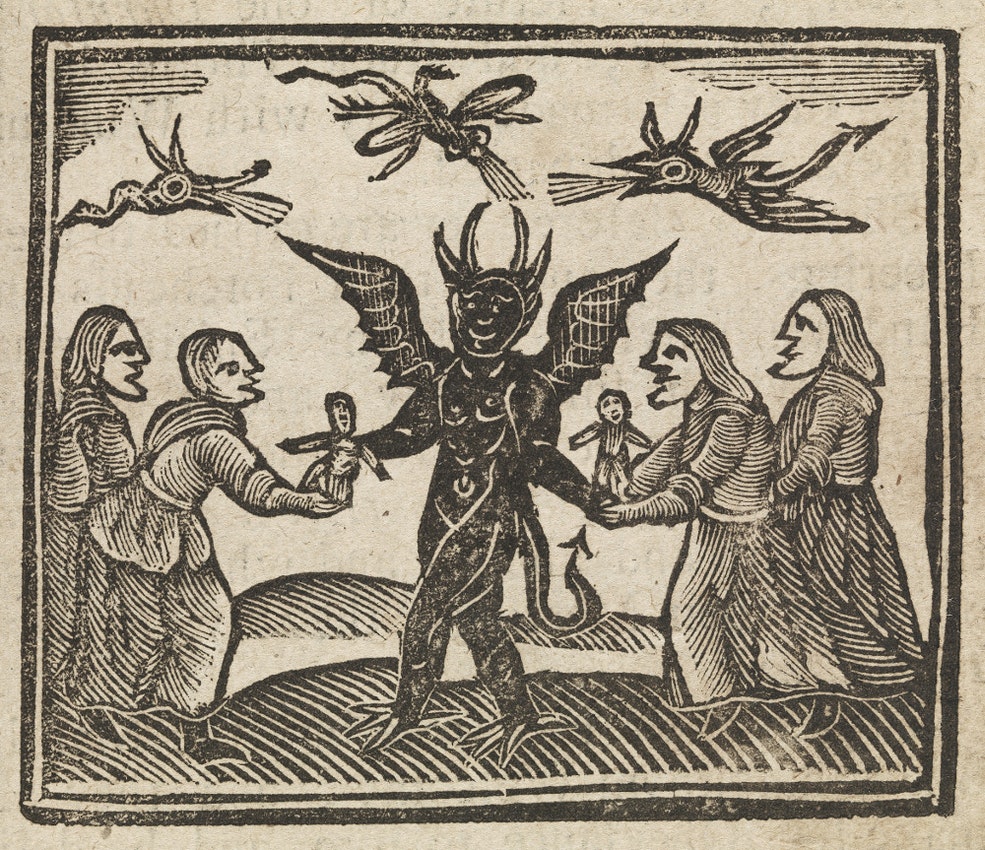
Witches presenting wax dolls to the devil, featured in The History of Witches and Wizards (1720)
At the turn of the 20th century, anthropologists and psychologists began to identify left-handedness with behavioural defects and abnormalities, associating lefthanders with a higher proportion of deviant acts. Cesare Lombroso — often considered to be the father of criminology — believed that those who favoured the brain’s right hemisphere (and therefore wrote with the left hand) were ‘primitive’ (charming!), while those who favoured the left side of the brain and wrote with the right hand were more ‘civilized’ and less inclined to criminality. It was believed that this could be corrected with certain types of behavioural reinforcements, which is why (until relatively recently in the UK!) left-handed children were often forced to write with their right hands.
Despite these theories being debunked, cultural preferences for right-handedness are still prevalent today, particularly in countries such as China where even the writing of Chinese characters often requires the use of the right hand.
Were there any upsides to being a ‘leftie’?
Was it all bad? Well, being a left-hander might have had some advantages. A theory exists that spiral staircases in castles usually turn clockwise as you ascend, in order hinder right-handed attackers. The reason being that it would make it more difficult for right-handed people to draw a sword – clearly, they didn’t foresee an army of left-handers!

The Adventures of Robin Hood (Michael Curtiz & William Keighley, 1938)
It’s also believed that the humble handshake originally developed in 5th century Greece as a way for each participant to demonstrate that neither of them carried a weapon in their right hand. Popular belief attributes the shaking element developing in Medieval Europe, in order to further ‘shake out’ hidden weapons. Deviant left-handers were therefore not to be trusted, as they could happily carry out the action with their right hand whilst lashing out with their dominant left.
Though these might seem like two pretty neat advantages, throughout history left-handedness certainly hasn’t been the most advantageous genetic trait to possess. The sad truth is that widescale distrust of, and prejudice against, lefties is ultimately to blame for ‘sinister’ taking on its ominous new meaning.

