Playtime at the museum
This summer, the museum is bringing back the popular ‘Marble Mania’ installation! And, to tie in with the theme of play, we’ve also added a new toy display upstairs. Read on to learn more on the history of playtime…
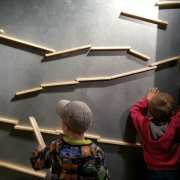
If you didn’t catch our giant magnetic marble run in 2019, then here’s a second chance to come and play! Have a go at making a marble run along the gallery wall, and then test your creativity by letting those marbles loose!

Mehen board & marbles | The British Museum
Did you know, the humble marble has been a popular children’s toy for thousands of years? There’s no conclusive evidence for where marbles actually originated, but they have been found in various forms worldwide. 4,000-year-old small clay marbles have been found in ancient Egyptian tombs, likely used as game pieces in the ancient game of Mehen, meaning ‘coiled one’, named after a snake deity. The playing board itself took the form of a coiled snake! Greek and Roman children are also known to have played with marbles in a game known as ‘Nux’ or nuts. Sadly, the game rules have been lost to us, but we know that, often, nuts themselves were used to play.
Homemade play

Peg doll bride, c. 1910
While you’re visiting the museum, you can also head upstairs to see a new display of local children’s toys dating from the early 1900s to the 1950s. The toys include a charming doll’s pram, complete with a china-headed doll, that belonged to a young girl who grew up in New Street, just a short distance from St Neots Museum. Also on display is a small peg doll dressed as a bride. She dates from around 1910 and is actually made from a wooden ‘dolly’ peg, used to hang washing on the line! The term ‘doll’ is thought to derive from a shortened pet name for ‘Dorothy’, which gradually began to be associated with any human like figure (which may also be where a ‘washing dolly’ gets its name from, due to its (albeit vague!) resemblance to a human.)

Peg doll with her pipe-cleaner arms!
Peg dolls were popular during times of hardship, such as wartime Britain, when people had little to spend on toys. This particular doll is dressed in cotton lace with a veil, and silk fabrics stitched to the peg underneath to form her undergarments and booties. Her arms are made from pipe cleaners, which enables her to carry her delicate real dried flower bouquet. Sweet!
Another example of an Edwardian homemade toy is the wooden ‘jumping jack’ sailor, who moves his arms and legs when you pull down on his string. Just like marbles, toys like this have also been found dating as far back as ancient Egypt. They were particularly popular in 18th century France, where the toys (called ‘Pontins’) were highly collectable and sought-after items, particularly those that imitated popular public figures of the time. In the Victorian period, paper ‘jumping jacks’ were popular, as they were easy to make and provided a low-cost option for poorer families.

Close up of the peg doll’s bouquet
Mass-produced toys
Other toys on display include a small selection of lead soldiers. Toy soldiers also have a very long history dating back to prehistoric times, including (you guessed it), in ancient Egypt! Tin soldiers were the first kind to be mass-produced in Germany in the 1700s. In 1893, the British toy company ‘William Britain’ revolutionised production by devising the ‘hollow-cast’ method, making soldiers that were lighter (and therefore cheaper!) than their German counterparts. In the Victorian period, toy soldiers were also being made of lead; at this time, there was only a limited understanding of lead as a poisonous substance that could cause serious illness and even death. Certainly, the harm that lead-poisoning could do to young children was not fully realised until the 1960s, when laws banning the manufacture of toys containing lead came into force in 1966.

Edwardian ‘jumping jack’ toy
Our tin doll’s tea set is another example of the cheap and cheerful children’s toys produced for a mass market in the early 20th century. Early tea sets like these from the 16th century would have been made from copper or pewter, though porcelain was also an option for those with the money! The popularity of these sets really took off during the industrial revolution, when they became more easily produced, and, by the 19th century, England was one of the leading producers of tin tea sets in the world.
The final addition to our collection is a 1950s Meccano set, given to the museum by a man who grew up in Russell Street. Meccano was invented in Liverpool in 1898 by Frank Hornby, who had originally intended it as an educational tool for children to learn the basics of mechanics. Marketed as the “toy of the century” during the height of its popularity in the 1950s, Meccano enabled users to build models of structures, vehicles and engines, complete with moving parts and motors.

