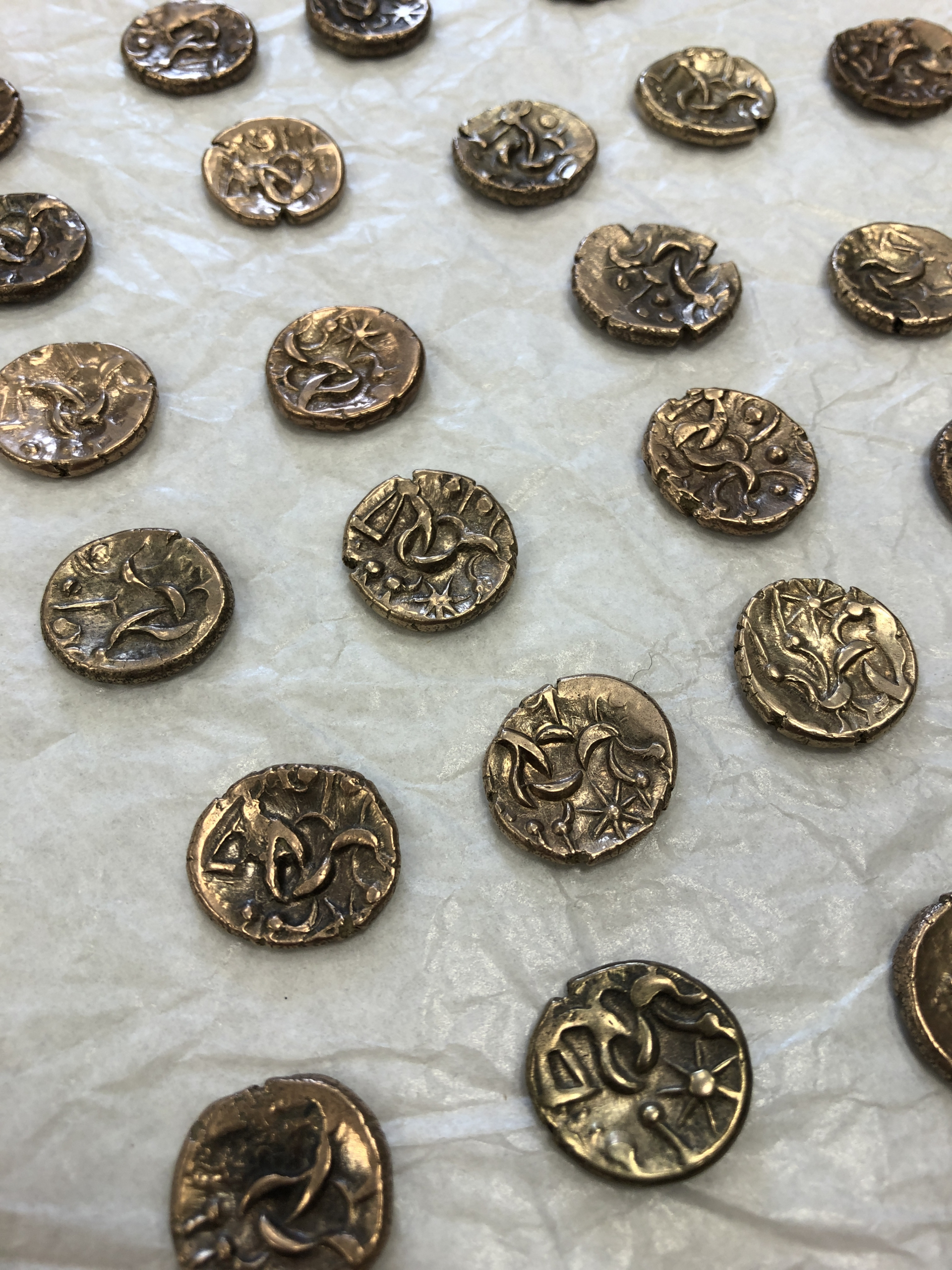
Our opening exhibition for May 2021 is Celtic Treasure, featuring the stunning Kimbolton hoard of Iron Age stater coins. Join Curator Liz Davies, as she tells us more about the coins, their designs, and their significance to the people who buried them in the ground nearly 2,000 years ago.
Find out more about the exhibition HERE, and read more about the coins HERE.
Our opening exhibition for May 2021 showcases the beautiful Kimbolton Coin Hoard of Iron Age coins, found at Kimbolton in 2010. Hidden in the ground for 2,000 years, our exhibition will uncover the story of their burial and their significance to the Celtic people that buried them.
Iron Age stater coin with quarter stater for size comparison
We say ‘gold’ coins, but in fact they’re really a mix of copper, gold and silver, with many containing less than 50% gold. You can tell from looking at the coins which have a higher percentage of silver due to the tarnish.
The Kimbolton Coin Hoard contains 68 gold coins, dated to about 100BCE-40CE. The coins were found close to the village of Kimbolton by a metal detectorist in late 2010, and subsequently identified as Iron Age ‘stater’ coins by the British Museum.
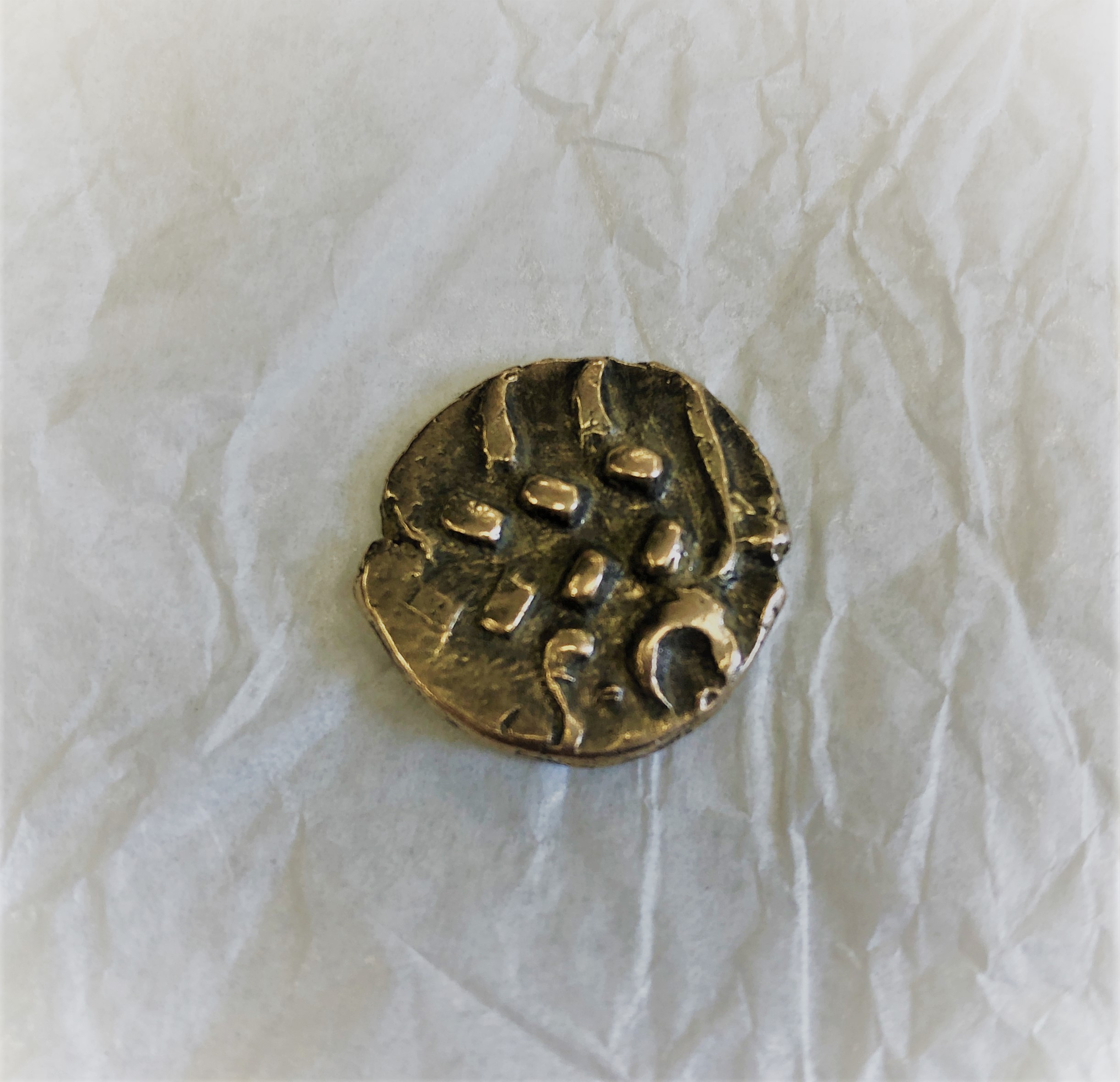
The 68th coin in the hoard is a gold quarter stater of Cunobelin, who was the powerful king of the Catuvellauni tribe, with influence over much of the East of England around 10-40CE. His coin displays an image of a horse and the letters CUN for Cunobelin, and on the other side an ear of wheat and the letters CAMV, indicating the coin was struck in Colchester, or Camulodunum as it was known in Roman Britain. The Catuvellauni occupied an area which roughly now covers parts of Cambridgeshire, Hertfordshire, Bedfordshire and Buckinghamshire, but his presence on a coin struck in Colchester suggests he also held a great deal of sway over the Trinovantes tribe, who held Colchester as their capital.
The discovery of this coin amongst the hoard really helps us to really narrow down the time period that the coins were buried. We know that the hoard must not have been placed in the ground any earlier than 10CE at the start of Cunobelin’s rule, though how long after this they were buried cannot be determined. Soon after Cunobelin’s death, a great power struggle for territory erupted between his sons and vicious fighting soon followed. Could this period of instability have been the driving force behind the coins’ burial, perhaps for safe keeping by their owners?
https://www.stneotsmuseum.org.uk/wp-content/uploads/2021/05/4.4.a.jpg5851100Jo Allenhttps://www.stneotsmuseum.org.uk/wp-content/uploads/2019/12/st-neots-museum-logo.svgJo Allen2021-05-04 11:42:372021-05-21 15:36:05Quarter stater of King Cunobelin
The Kimbolton Coin Hoard. Image Copyright St Neots Museum
The Kimbolton Coin Hoard. Image copyright St Neots Museum
Iron Age stater coins
Detail of Kimbolton coins, showing abstract horses.
Detail of Kimbolton coin showing remnants of Apollo’s laurel wreath and hair locks
The Celts worshipped the sun and often used the symbol of a wheel to represent the sun gods or solar calendar in their art. This deeper meaning attached to the wheel could be why it survives as the only original part of the Greek chariot.
Iron Age stater coin with quarter stater for size comparison
We say ‘gold’ coins, but in fact they’re really a mix of copper, gold and silver, with many containing less than 50% gold. You can tell from looking at the coins which have a higher percentage of silver due to the tarnish.
Obverse of the stater coins showing how the design stamped on the concave side of the die is less distinct during the striking process
The Kimbolton Coin Hoard contains 68 gold coins, dated to about 100BCE-40CE. The coins were found close to the village of Kimbolton by a metal detectorist in late 2010, and subsequently identified as Iron Age ‘stater’ coins by the British Museum. They were declared ‘Treasure’ under the Treasure Act of 1996; due to this, for security reasons we are only able to display five of these coins permanently in the museum collection.
Kimbolton coin hoard, copyright St Neot’s Museum
The coins
The ‘gold’ coins are actually a mix of copper, gold and silver, with many coins containing less than 50% pure gold. You can tell from looking at the coins which have a higher percentage of silver due to the tarnish present. 67 of the coins are uninscribed Iron Age gold coins, of a type known as ‘South Ferriby’ staters. The coins were mostly minted in the Lincolnshire area by the Corieltauvi tribe, and seem to have been in quite wide circulation, with examples commonly found in East Anglia and around the Fen Edge. Kimbolton, however, falls beyond the main distribution area for these coins, making their discovery all the more extraordinary, and indicating they were in much wider circulation than previously thought.
The 68th coin in the hoard is a gold quarter stater of Cunobelin, who was the powerful king of the Catuvellauni tribe. You can read more about this coin here.
Gold staters are thought to be the first type of coins ever to circulate in Britain, though it is not certain whether these coins were ever actually used as currency (due to the value of the metal) or whether they were instead used as gifts or religious offerings to the gods.
Links with the Mediterranean
The design of these coins is evidence of the long-standing trade links already in existence between Britain and Europe. The Greek writer Strabo (writing about 64BCE to 23CE), recorded that the British were well known for their exports of grain, cattle, gold, silver, and iron.
Philip II of Macedon as the god Apollo, with chariot on the reverse of the coin
Imagery on the coins appears to be closely based on stater coins issued by the Ancient Greek King Phillip II of Macedon, who ruled from 359 – 336BCE. The Kimbolton coins depict the remnants of laurel wreaths, like those worn by the Greek sun god Apollo and by Phillip II himself, along with stylised, abstract portrayals of chariots and horses, also present on the original Greek coins. Some of the ‘sun’ like symbols are actually thought to be spoked wheels, which in turn may represent the sun. The sun is an important focus of worship in pagan societies, and many Celtic deities had solar attributes. The god known as Taranis identified as god of thunder and the sky, and was often depicted alongside a ‘spoked wheel’, which represented either the sun or the solar calendar.
Detail of Kimbolton coins, showing abstract horses.
Horses are a common presence on Celtic coins, perhaps due to their common occurrence in Celtic mythology or due to their importance as a status symbol for the elite members of society. Originally, Celtic coins were often copies of Greek or Roman coins, and so the early horses depicted were realistic. However, the horses soon became highly abstract as the Celts made the images their own. On the Kimbolton coins, the horses are depicted using a series of lunate (or crescent) symbols. Their appearance on the coins alongside rosette ‘sun wheels’, moon and star symbols are thought to be a reference to the god Belenos, a solar deity who was thought to ride the sun across the sky in a chariot in Celtic mythology.
On the other side of the coins, all that remains of the god Apollo is a pattern of abstract dots and shapes representing his hair locks and laurel wreath. This can be hard to see on first appearance, but if we compare the coins with the earlier, more realistic representations, we can see which stylistic elements have been kept to symbolise these key features. On some of the Kimbolton coins, the remains of the laurel wreath look rather like stylised depictions of ears of wheat, and may have been intended to represent the grain grown by local Celtic tribes and then traded with the Roman world – a source of great wealth and prestige for tribal leaders. Read more in our blog – Deciphering our Celtic coins
Detail of Kimbolton coin showing remnants of Apollo’s laurel wreath and hair locks
The Minting Process
The coins were struck, which means they were made by placing a blank piece of metal between two moulded ‘dies’ and struck with a hammer. The dies (one for each side of a coin) would have had an inverse version of the image to be struck on the coin. The lower die would be concave in order to hold the blank piece of metal in place while the upper die would be convex. When we look at the Kimbolton coins, we can see that the horse designs on the concave side of the coin are slightly clearer, perhaps due to the direct contact of the hammer on the die.
When it comes to design, there’s a good amount of variation on the Kimbolton coins. Some of this is down to different image templates on the dies being used, and in other cases, we can see that coins have been cast from the same dies, but still aren’t quite uniform. Dies were manufactured individually by hand, and it wasn’t unknown for dies to remain is use when they became worn or even when cracked. Variation in the appearance of the coins, then, could be due to the dies losing their definition with age, or perhaps due to misalignment when the coins were struck.
Obverse of the stater coins showing how the design stamped on the concave side of the die is less distinct during the striking process.
Local Significance of the Hoard
The hoard provides exciting new evidence of a wealthy Iron Age / Romano-British community in our area during the period between Caesar’s invasion in 55BCE and Claudius’ conquest in 43CE. We know that the Ouse valley in Huntingdonshire and Bedfordshire was intensively farmed in pre-historic and Roman times, but we have only limited evidence to tell us where people actually lived.
Results from the recent A14 excavations in this area show that Iron Age settlements were situated every 0.5 kilometres, which gives an idea of how densely the landscape was settled. Excavations at Loves Farm from 2005-2008 on the outskirts of present-day St Neots, have revealed evidence of settlement and associated activity spanning over 5,000 years. From around 200BCE to 550CE the site was occupied by an agricultural community, who created many of the landscape features that we see today. The excavations revealed a diverse landscape, with evidence of housing, farming, industry and trade, religion and ritual activity. The discovery of this Iron Age hoard on agricultural land at Kimbolton highlights the wide spread activity in the area.
Who did the coins belong to?
The presence of the coins suggests that some inhabitants of Kimbolton at this time were wealthy. The coins may have been collected by a single wealthy family as their life savings, or perhaps belonged to a group of people (an extended family or small group of families), who lived close to each other and pooled together their savings. The coins could have been buried for safe keeping, or perhaps as a religious offering to local deities. Substantial offerings to the gods like these are not unknown (locally at Snettisham, gold torcs have been found deliberately placed in the ground, likely as offerings), and may have been more common in times of conflict as offerings for peace.
Iron Age stater coins with quarter stater of Cunobelin
The burial of the hoard could indeed reflect the unsettled times across Eastern England from 55BCE to 43CE, during the period of the Roman conquest. Huntingdonshire was the boundary for three powerful Iron Age tribes: the Iceni (of Boudicca fame, based in Cambridgeshire, Suffolk and Norfolk), the Catuvellauni (whose principal town was St Albans), and the Trinovantes (based in what is now Essex). A string of hill forts across the county from Stonea in the Fens to Borough Hill at Sawston probably marked the Iceni border. Power struggles and intermittent warfare between these tribes were common, and particularly so after the death of Cunobelin in 40CE. In 43CE the emperor Claudius successfully invaded and conquered Britain by taking advantage of the rivalry between these warring tribes, joining forces with the Trinovantes to achieve dominance.
The Trustees and Curator of St Neots Museum would like to thank everyone who made a donation to our appeal fund, without your help we would not have been able to purchase the coins for display.
Major Donors:
V&A Purchase Grant Fund The Headley Trust & Museums Archaeological Acquisition Fund The Goodliffe Fund of the Huntingdonshire Local History Society St Neots Museum Trustees
Other local group donors include:
The Friends of St Neots Museum St Neots Local History Society Kimbolton Local History Society St Neots St Mary’s Rotary Club St Neots and District Artefacts Club Crosshall Junior School
 St Neots Museum
 St Neots Museum
 St Neots Museum


 St Neots Museum