St Neots’ strange link to the Georgian transatlantic slave trade
As communities across the UK have struggled with the rights and wrongs associated with the removal of statues, and other memorials, to those who had links to the slave trade, we took a look at St Neots’ own past links with the trade in human lives.
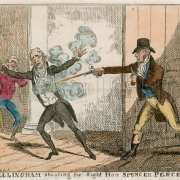
After some research, our curator discovered an unexpected link through local man John Bellingham who assassinated the British Prime Minister, Spencer Perceval, on 11th May 1812. Perceval was strongly against the slave trade, and his death at the hands of Bellingham, was likely the result of his fight against the anti-abolitionists…
Bellingham’s backstory

John Bellingham, 1816
After spending much of his childhood in St Neots, Bellingham became an accountant and moved to Liverpool where he aspired to become a merchant, hoping to make his fortune through the valuable shipping trade with Russia. Unfortunately, things didn’t work out too well for Bellingham, and on only his second trip to Russia he fell out with his business partner, was accused of being in debt, and imprisoned in Russia for five years. Not a great start! When he was finally released from prison in December 1809, Bellingham returned, penniless, to Liverpool, and once back home, became obsessed with claiming compensation from the British government. Bellingham petitioned everyone from the Prince Regent to the Prime Minister, but was unsuccessful in his attempts.
Perceval’s fight against slavery
Meanwhile, the new Prime Minister, Spencer Perceval, was set in his determination to end the transatlantic slave trade. Although it had officially been abolished in Britain by an Act of Parliament in 1807 (making it a crime to purchase, transport or sell people as slaves), it was so profitable, and had become so embedded in trade between Britain, America, Africa and Europe, that merchants found ways round the Act. Ships were falsely registered under the flags of foreign countries who had not banned slavery, and forged documents to enable the illegal trade to continue. In further attempts to end the trade, Perceval introduced additional powers to prevent ships carrying slaves and to free captured Africans before they were transported to the Americas. He also increased the size of a Royal Navy patrol along the coast of West Africa to inspect any ship suspected of breaking the law!

Spencer Perceval
Unfortunately, Perceval’s new measures, though fully justified, caused such wide-scale disruption to all transatlantic trade, that trade with the United States fell into decline and an economic depression spread across Britain. Particularly badly hit was Liverpool, bringing hardship and unemployment to many in the city. Not surprisingly then, Liverpool merchants felt angry, and blamed Spencer Perceval for their situation, with the Liverpool Mercury suggesting that the ‘assassination of a tyrant’ (Perceval) could only be for the greater good!
A puppet on a string
Now, the wishes of Liverpool merchants to get rid of the Prime Minister merged conveniently with John Bellingham’s desire for justice from the government for his Russian losses. At his later trial in London for Perceval’s assassination, it was revealed that during his five months stay in London in 1812, Bellingham had received mysterious ‘maintenance’ payments which had enabled him to rent a room, purchase pistols, plan his crime and finally carry it out. The late Andro Linklater, who wrote a fascinating book ‘Why Spencer Perceval had to Die’ believed that Bellingham may have received the payments from an American or Liverpool merchant who had indeed decided to act against Perceval. Whatever the motive, measures against the slave trade were dropped soon after the death of Perceval. It’s not beyond the realms of possibility, then, that Bellingham, too caught up in his own feelings of injustice, was an unwitting pawn in the power struggle between the pro and anti-slavery factions.