Deciphering our Celtic coins

From the realistic to the abstract, we take a look at how to decipher the imagery on our collection of Celtic gold coins.

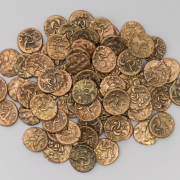
We’re planning on reopening our museum doors on Tuesday 18th May, and we’re kicking things off with a treasure of an exhibition! The Celtic Kimbolton coin hoard was discovered by a metal detectorist in 2010, and our museum is now the honoured custodian of this stunning collection or Iron Age currency. Minted around 2,000 years ago by the Corieltauvi tribe (whose territory lay north of St Neots, stretching from Hull in Lincolnshire and across to Leicester), the coins mostly date from 100BCE – 40CE, during the period of the Roman conquest of Britain.

Imagery on the coins

Apollo with chariot on the reverse of the coin, from the Kingdom of Macedon

The designs on the Kimbolton coins are fantastically abstract, but we know that they’re based on a particular coin issued by the Greek king, Philip II of Macedon, who ruled 369 – 336 BCE. On one side, this coin featured the head of the god Apollo, adorned with a laurel wreath headpiece, and on the other, a chariot pulled by horses. Though the Celts worshipped different gods to the Greeks, the imagery on the coins held significance to them within their own religion and customs. So, enacting the age-old theory of “if it aint broke, don’t fit it”, the Celts adopted this imagery as the foundation for their own currency.
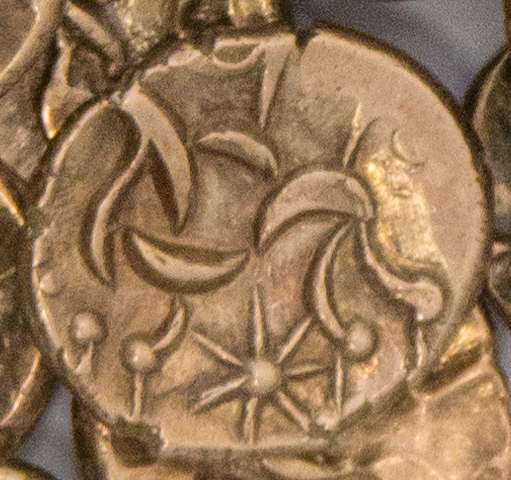
Close up of one of the Celtic coins from the Kimbolton hoard, depicting a horse and chariot. Copyright St Neots Museum

At first, the Celtic coins were often direct copies of the Greek coins, maintaining the realistic imagery. However, over time the designs began to morph, becoming highly abstract as the Celts made the images their own. By the time the Corieltauvi tribe had redesigned their coins, they were a long way away from the originals!

Unless you know what you’re supposed to be looking at when you study the Kimbolton coins, you’d be forgiven for thinking that the designs were simply a mixture of shapes and pleasing patterns. BUT there’s more to them than meets the eye, and you might be surprise to learn that they do still depict the same images as the Greek coin above! Don’t believe us? Let’s take a closer look…

Deciphering the Celtic coins

Abstract horse, with rosette and spoked wheels. Image copyright St Neots Museum

Of the two sides of the coins, the horses and chariots are perhaps the easiest to visualise. The horses are constructed by a series of lunate (or crescent) shapes and a triangular head, which has been deciphered as both a harness or even a nose-bag. The chariot often remains solely in the form of a singular spoked or rosetted wheel, which, in Celtic mythology, had links to the sky or solar deities. The Celts worshipped the sun and often used the symbol of a wheel to represent the sun gods or solar calendar in their art. This deeper meaning attached to the wheel could be why it survives as the only original part of the Greek chariot.

The horse was also worshipped by the Celts and was very important in their society. It was used by elite warriors to ride into battle and as a status symbol by those who could afford to own one. Their appearance on the coins alongside pelleted or rosetted ‘sun wheel’ symbols are thought to be a reference to the god Belenos, a solar deity who was thought to ride the sun across the sky in a chariot in Celtic mythology.

An abstract representation of Apollo on the Kimbolton coins (Click to enlarge)

And what about Apollo?

Turning our attention to the other side of the coin, and what remains of Apollo is, err, slightly more difficult to make out! Now, all that’s left is a pattern of abstract dots and shapes representing his hair, face and laurel wreath. This can be hard to see on first appearance, but if we compare the coins with the earlier, more realistic representations, we can see which stylistic elements have been kept to symbolise key features, like his locks of hair, for example.

On the Kimbolton coins, the remains of the laurel wreath look rather like stylised depictions of ears of wheat, and may have been intended to represent the grain grown by local Celtic tribes and then traded with the Roman world – a source of great wealth and prestige for tribal leaders.

Tribute to the gods?

But why more focus on religious imagery on the coins rather than, say, the heads of tribal leaders? Well, it’s long been speculated, that as well as currency, coins were used as offerings to the Celtic gods, and often buried in the ground like the Kimbolton hoard. Offerings may have been more common in times of conflict as pleas for peace and stability, so could it be that the hoard was buried as an offering for protection against the Roman invasion? Or were they simply buried for safe keeping? Sadly we’ll never know, but it’s tempting to guess nonetheless!

For your chance to take a closer look at these stunning coins, drop in to the museum between 18th May and 5th June. You can also read more about the Kimbolton hoard by clicking HERE.

The Kimbolton Coin Hoard. Image Copyright St Neots Museum
Unicorns – a brief history

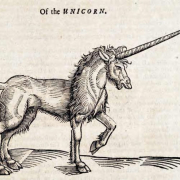
From ferocious beasts to friendly rainbow spouting mascots, it turns out that unicorns have been around in some form or other from the earliest of civilisations. As April 9th marks National Unicorn Day, we thought we’d take the chance to briefly trace some of their natural history…

Uncertain beginnings

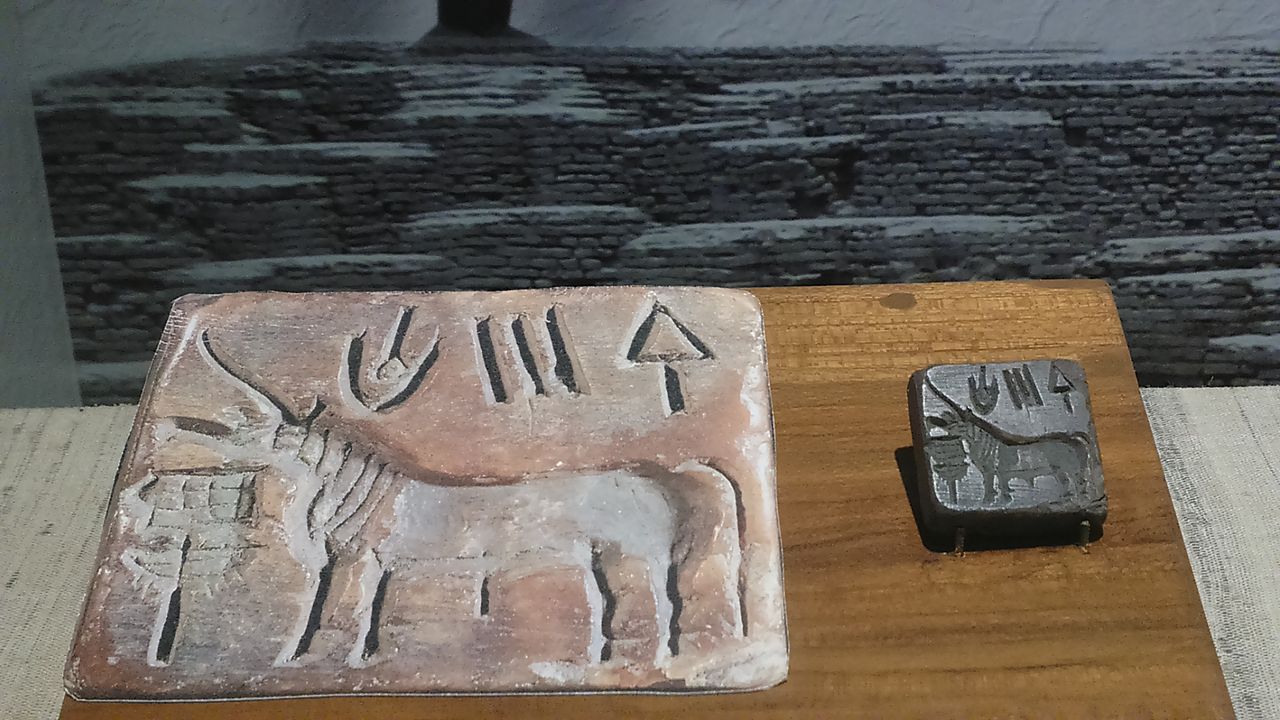
The first dubious nod to unicorn mythology comes from the Indus Valley Civilisation, which, together with ancient Mesopotamia and Egypt, formed one of the three powerhouse civilisations of the ancient Near East c. 3000 – 1300 BCE. Imagery on seals belonging to elite members of society depict a horse like animal (shown in profile) with a single horn protruding from its skull. Granted, this early link to unicorns IS a tenuous one, and it’s much more likely that these are instead representations of aurochs – a type of large wild cattle that formerly inhabited Europe, Asia and North Africa.

A case of mistaken identity

Indus Civilisation seal of a possible unicorn at the Indian Museum Kolkata.

The first written evidence we have for unicorns appears in ancient Greece, not (as you might expect) in writings of mythology but in ‘natural history’ writings, once again on the ancient Near East. The earliest accounts come from the writer Ctesias in the 4th century BCE. In his book Indika (On India) he includes one of the first references of a unicorn, describing them as a type of wild ass: “fleet of foot, having a horn a cubit and a half in length, and coloured white, red and black” – fancy! In the same writings, he also includes descriptions of the oryx (a type of antelope with similar colourings described above) so it’s likely that the two were one and the same.

In the 1st century CE, Pliny the Elder writes of a fierce animal he calls the ‘monokeros’ (or ‘single horn’, a word with etymological links to ‘unicorn’) which “has the head of the stag, the feet of the elephant, and the tail of the boar, while the rest of the body is like that of the horse; it makes a deep lowing noise, and has a single black horn, which projects from the middle of its forehead, two cubits in length”. Not the usual imagery we’d associated with these majestic beasts, and no prizes for guessing the animal he was actually describing! Later, in the 13th century, Marco Polo would add to this unflattering description of a unicorn by adding that “they spend their time by preference wallowing in mud and slime” – hardly rainbows and sparkles!

Aurochs in a cave painting, Lascaux, France

Obviously, in each of the above cases we’re witnessing a great deal of mistaken identity, but, pieced together from all of these accounts, the myth of a single horned beast, known as the unicorn, was born.

Masters of evasion

Along with their physical description, Pliny is also amongst the first writers to describe the unicorns’ character traits, stating that they were amongst the fiercest animals in India and impossible to be captured alive – this would become a running theme to their mythology, particularly in the medieval period.

Writing in the 6th century CE, Cosmas Indicopleustes (a travelling merchant from Alexandria), gives a wonderful account of the unicorn’s notorious ability to avoid capture. He tells us that all the unicorn’s power resides in its horn, and when placed in danger, a unicorn would happily throw itself from a cliff to escape, landing expertly on the point of its horn unharmed… Disappointingly, he’s silent on how it then unplugged itself from the ground. Shame.

Unicorns in Christianity

Unicorn from a 13th century church floor, Ravenna, Italy

It’s said that a mistranslation of the bible’s old Hebrew text, even led to the unicorn being mentioned in some versions of the bible. A supposed error when translating the Hebrew term ‘Re’em’ (ox) as ‘monokeros’ effectively changed the word ‘ox’ to ‘unicorn’.

In the 2nd century CE, a Greek Christian text known as the Physiologus (widely seen to be the predecessor of the popular medieval ‘bestiaries’, or ‘books of beasts’) further made popular the allegory that unicorns were strong, fierce, animals, adding that their horn could purify poisoned waters. The book also strengthened another popular belief that had developed, which was that unicorns could only be subdued with the cooperation of a virgin maiden, as unicorns were said to become loving and docile in their presence. This, along with their purifying characteristics, subsequently led to Christ himself being associated with the unicorn, and medieval artwork often depicted a unicorn as a metaphor for Christ.

The Maiden and the Unicorn by Domenichino. Image from Alinari Archives/CORBIS

Symbols of chivalry

In medieval Europe, the unicorn became a symbol closely associated with chivalry, with heroic lovers and their lady companions often compared to the doting relationship between the unicorn and a virgin. During the Renaissance, in a move away from the Christian allegory, the unicorn became a secular symbol of chastity and loyalty.

From the 15th century, unicorns also started to become popular in heraldry, frequently depicted as a horse with a goat’s hooves and beard, and a delicate spiral horn. They’re often also shown as collared with a broken chain, perhaps as a nod to their immense power and ultimately untameable nature. In Celtic mythology, the unicorn is a symbol of purity, innocence and power, and so became an obvious choice for Scotland’s royal coats of arms.

Healing qualities

Scotland’s Royal Coat of Arms

The purifying qualities associated with the unicorn’s horn was such a popular legend that cups reputedly made of unicorn horn were highly valued by medieval nobility as a protection against poisoning. In reality, these cups were most likely made from rhinoceros’ horn or narwhal tusk!

AND unicorn horn as a means for protection didn’t end there… In the 17th century, London newspapers often contained advertisements for miracle elixirs made of “true Unicorn Horn”. These were said to relieve a full-on list of diseases from ulcers and scurvy, to melancholy and fainting spells.

From reality to mythology

‘The Lady at the Unicorn’ tapestry, from a series made in France circa. 1500 – this one representing ‘sight’

Sadly, by the 18th century, belief in unicorns began to wane, as more of the world was explored and traces of these majestic animals were unfounded. It wasn’t until the Victorian era when the now famous ‘Lady and the Unicorn’ tapestries (made around 1500, and widely considered to be amongst the greatest pieces of medieval art) were rediscovered, and romanticised by Victorian artists. From this point onwards, the unicorn as a glamorised mythical beast grew in popularity, leading us right up to the present day where the unicorn trend is booming! From unicorn coffees and bagels, to emojis and a whole plethora of accessories, the unicorn ‘brand’ is now inescapable.

It’s certainly come a long way from its ferocious origins!