Spring is finally here, which can only mean that Easter is just around the corner… One way in which we’ll likely all be celebrating is by buying and eating a chocolate Easter egg, delivered by the Easter Bunny no less! But why are we eating chocolate eggs, and just where did this benevolent bunny spring from? Read on to find out…
As with so many of our ancient customs, the origins of the festival reach far back into the pagan past when our ancestors, as rural farmers, needed to make winter food supplies last until the first crops and animals were ready to eat. Early people believed that the sun went to sleep during the winter, and held celebrations (including the lighting of fires and eating special foods) in spring to welcome the sun back from its rest.
The Easter Bunny

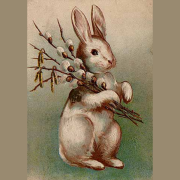
Easter Hare, c.1910
The Easter bunny began life as the Germanic and Saxon goddess of the dawn and the spring, Eostre, whose sacred animal was the hare. The origin of her name comes from the Old English Ēastre, a word referring to “the rising dawn” and the sun rising directly in the east at the spring equinox, marking the time when the natural world comes to life again after the winter. Hares are of course just one of the many animals that breed in the spring – the way that female hares ‘box’ away over-eager males led to the idea of ‘mad March hares’ – but it was their strong association with the goddess that sealed their link with Easter.
Some experts believe that it was ancient confusion over the simple nests (called ‘forms’) that hares make on open ground, with the nests certain types of ground-nesting birds make, which led to the belief that hares laid eggs! Even once this belief was disproved, the idea and imagery clearly stuck!
The hare becomes a bunny

Coneygeare, Eynesbury
The brown hare is native to England and experts believe that rabbits, native to Spain and France, were introduced into the wild in Britain by the Normans after 1066. These rabbits soon multiplied, vastly outnumbering the native hare. Their skill for reproducing, perhaps, made them a more suitable symbol for fertility and rebirth.
We suspect that rabbits were being farmed in Eynesbury during the medieval period because an area close to the River Ouse is still known today as the ‘coneygeare’. Coney was the old name for a rabbit and a ‘coneygeare’ was a rabbit warren. These warrens were large earth mounds in which the rabbits could easily make their burrows and then be farmed for food by the warren keepers.

A Medieval rabbit warren
Very recent research conducted on a rabbit bone from Fishbourne Roman palace has also raised the intriguing possibility that the Roman family who lived there were keeping rabbits as pets. As wild rabbits were not known in England until the Norman invasion, it seems that they did a good job of keeping those bunnies in captivity!
And what about those eggs?
Along with their misguided association with the hare, eggs are also a very ancient symbol of fertility and new life. Decorating and giving eggs to symbolise the rebirth of the world, lighting bonfires, feasting, singing and dancing were all ancient ways of celebrating the arrival of spring. As Christianity began to spread through the Roman Empire, older pagan practices merged with newer Christian ones and the egg was adopted as a symbol of Christ’s resurrection from the tomb. In the Tudor period in England, ancient lore said that the sun danced with joy at the resurrection of Christ at Easter, linking the old and new beliefs together.

Cadburys Easter Egg, 1925. Image: Cadburys
In Germany, the Easter hare was said to bring a basket of painted eggs to good children, and these would then be hidden for the children to find. Queen Victoria, whose mother was German, organised egg hunts for her children at Kensington Palace and this helped to bring the tradition to Britain. The first chocolate Easter eggs were made in France at the court of Louis XIV (1643 – 1715) and it was not until 1873 that Fry & Sons made the first chocolate eggs in England, followed by Cadbury’s in 1875. These eggs were expensive and it was only after the Second World War that the price of chocolate eggs fell, making them a treat that everyone could afford.
Easter traditions around the world

Best bonnets at an Edwardian Wedding
Here’s a few more Easter traditions you might not have heard of… In St Neots it was considered proper, and also lucky, for women to wear new clothes when they went to church on Easter Sunday. From this popular custom (which is found across Europe) developed the idea of wearing a new hat or ‘Easter Bonnet’ on Easter Sunday, and in some parts of the world Easter parades developed.
In Sweden fireworks were set off at Easter to frighten away witches, and in Scandinavian countries people decorated branches and twigs with ribbons, as well as painting eggs and feathers.
In Germany there’s a tradition that an egg laid on Good Friday will last for 100 years! And back in Britain, an old Easter game involved rolling hard boiled eggs down a hill. This can still be seen at Preston in Lancashire, and in America where an egg rolling competition is held each Easter on the lawn in front of the White House in Washington.
So whether you’re nibbling away at a choccie egg or decorating your own, we wish you a very happy Easter!