Surviving the odds – the story of the St Neots Quads
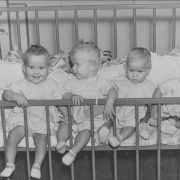
The Miles quadruplets, Ann, Ernest, Paul and Michael, soon to be known the world over as the ‘St Neots Quads’, were born on 28 November 1935 at 13 Ferrars Avenue, Eynesbury. They were the first British multiple birth babies to survive for more than a few days, and instantly became local celebrities. This is their story…
At first, Walter and Doris Miles and their two-year-old son Gordon believed they were expecting the addition of twins to the family. However, with just a few months to go before their birth, three babies were identified in an x-ray, and, as we all know, a fourth surprise was fast on its way!
A medical miracle

With their father, Walter Miles, at Ferrars Avenue, November 1935
The babies were delivered just over seven weeks early by local GP Dr E. H. Harrisson, District Nurse Mailing, and Mrs Miles’ mother; Ann weighing 3lb 12½oz, Ernest 3lb 5oz, Paul 3lb 7oz and Michael at just 2lb 13oz. All were typical premature babies; small, thin and incredibly weak. Their finger and toenails had not yet developed, and they were unable to maintain their body temperatures without assistance. Directly after the birth, Michael, the last to be born, had trouble breathing and had to be given artificial respiration for over fifty minutes before he began to breathe unaided. As they were so tiny, the babies could only suckle weakly and were initially fed sterilised water from a teaspoon by Mrs Miles’ mother.
The press goes quads crazy

The Daily Mirror front page, 29th Nov. 1935
The birth of the quads was an absolute sensation in depression era Britain, and attracted worldwide interest. The four babies became instant celebrities, and their every action was reported in the national and local press. The similar birth and survival of the Dionne quintuplets in Canada in 1934 and the Johnson quadruplets in New Zealand in March 1935 had fascinated the general public, and the quads were no different. Though they were born in Eynesbury, the quads were almost immediately renamed the ‘St Neots Quads’ by the press.
Dedicated medical care
Medical knowledge about how to care for extremely premature babies had come on in leaps and bounds since the early 1900s. Almost at once it was realised that the quads could not be cared for in their parents’ home, as they would need long-term specialist care. Their GP, Dr. Harrisson, decided that the best course of action was to move the babies to his home, The Shrubbery, in Church Street St Neots, where they could have their own dedicated nursery away from the press and well-wishers.

The Quads with Dr Harrisson and Mrs Miles
On the 30th November, they were moved to The Shrubbery and installed in a large south-facing bedroom, which acted as their nursery. Here they were able to be to be kept free from infection, and in a warm (constant 25oc / 78F) and humid atmosphere. To ensure the babies had the care they needed, a team of four specialist nurses were sent from Great Ormond Street Hospital, free of charge, to care for them. For the first few weeks, the babies were not bathed, but were rubbed all over with olive oil. They were fed with milk fetched twice daily from Queen Charlotte’s Hospital, London, that initially had to be skimmed and diluted by 50% to enable the babies to digest it!
Family life

At first, the babies were identified by different coloured wool around their ankles
The high risk of infection, coupled with the need to keep the babies in a warm stable environment, meant that, in the early months, their parents were only able to see them occasionally. It sounds like an unbearable situation for Mr and Mrs Miles to be under, but it also meant that the pair were able to regain some balance and prepare themselves for life ahead. Understandably, Doris Miles needed some time to recover from the birth of her four babies, and Walter Miles was in full-time employment, which he needed to retain if he was to support his much bigger family! There was also Gordon to care for, who was still just a toddler and demanded all the attention that toddlers bring.

Christmas day with the quads
Time spent with the quads was cherished, however, and the photo opposite shot by Gaumont British Films for a cinema reel, shows Doris and Walter visiting their babies at the Shrubbery on Christmas Day. Much like with the current pandemic era, face masks need to be worn to help prevent infection in the babies.
Supporting the family
Dr. Harrisson realised immediately that caring for the four tiny babies was going to be enormously expensive, and suggested that a fund should be started to help Walter and Doris Miles care for their children. He estimated that at least £5,000 would be needed, with the local paper noting that Mr Miles was earning just £3.00 a week.

Bounty of £4.00 from the Keeper of the Privy Purse
Existing support was available to the family in the form of a Royal Bounty, first established by Queen Victoria in 1849, for each child of a multiple birth “to enable the parents to meet sudden expenses thrown upon them”. Mrs Miles received a Bounty of £4.00 from the Keeper of the Privy Purse shortly after the birth of the babies.
From the 29 November, the St Neots Advertiser opened a fund to help provide for the babies, and donations started to flood into the newspaper offices on St Neots Market Square, and at the homes of both Dr Harrisson and Mr & Mrs Miles. Many donations came from local people, but also from across the country, and were listed each week in the newspaper.
Brand ambassadors

The quads receive their first bath by nurses from Great Ormond Street
As the weeks went by, the quads continued to thrive, and on 1 February, the babies had their first actual bath with soap and water! Their lives continued to be carefully regulated, and their diets were monitored daily. Gradually, they were able to digest ordinary breast milk and then moved on to unsweetened condensed milk with added sugar.
Soon afterwards, the babies moved to Cow & Gate ‘Frailac’, followed by Cow & Gate Half-cream Milk, and this began a longstanding connection with Cow & Gate. The company supported the Miles Quads for many years, including helping the family to build a nursery at their new home at 27 New Street, providing baby milk and weaning foods, giving them birthday presents, and finally a grand 21st birthday party in 1956 with other multiple birth babies raised on Cow & Gate Milk. The Quads appeared in many Cow & Gate advertising campaigns, with the income this provided helping Mr and Mrs Miles to bring up their miracle babies.
Legacy

Image from a version of the card game ‘Snap’ by Cow & Gate
The quads benefited greatly from the external support of health-workers, media, and sponsors, but in the end, it was thanks to the care and love of their sensible and down-to-earth parents that they all grew up to lead normal, successful lives. They remained local celebrities throughout their childhoods and were often asked to open fetes, attend special events and pose for photographs. In May 1944, they helped to launch ‘Salute the Soldier’ Week in Sandy, dressed to represent Britain, America, China and Russia.
And it wasn’t just the quads themselves that helped to benefit the community, as a newspaper article from September 1939 reveals. At the outbreak of the war in autumn 1939, Dr Harrisson was asked to help out at the new maternity hospital that was being set up at Paxton Park, Little Paxton. This grand Georgian mansion had been requisitioned as a safe place for expectant mothers to give birth, away from the feared air raids on London.

The quads at the ‘Salute
The Soldier’ celebrations in May 1944
Already by the date of the article, twenty babies had been born at the hospital, and up to three hundred babies were expected to be delivered by Christmas Day! The article reveals that Doris Miles had given the outgrown cots and baby baths used by the four Quads to the new maternity hospital, in order to help a new generation of babies. Today, St Neots museum has one of the cots (above) on display in the Home Life Gallery, and who knows how many babies may have used it over the years?
You can also take a look at these wonderful film reels of the quads growing up, available from British Pathé on YouTube.


