St Neots Stories

We’re launching a brand-new project and we need your help!

As the museum is due to be closed for some time because of the pandemic, we’ve been busy working out new ways in which to keep connected with you, our local community, as well as keeping the history of the town alive and accessible. With this in mind we’re launching St Neots Stories, giving YOU the opportunity to curate the town’s history, by sharing your personal memories, stories and photos of the town.

How it works:

We want to hear about anything, from school memories to sporting triumphs. Whether your family has lived in St Neots for generations, or whether you’re new to the town, we want to hear from you! Every memory and photo you send to us will be held in our collection and made accessible to the community via our website as an online resource; and we will also be featuring some of the photos and stories we receive on our social media pages using the hashtag #StNeotsStories.

By collecting these together, we hope to create a more vibrant and relevant digital record of the town, for both current and future generations.

How to submit:

To get involved, all you need to do is send your story to hello@stneotsmuseum.org.uk, including the following information:

  1. The memory or story you’d like to share (please include as much info as you can!)
  2. A photograph or image to support your memory or story
  3. Your name and some background on your connection with the town
  4. A photo of yourself today (if you are happy to do so)

By taking part in the project you are giving your consent for St Neots Museum to use your story and images across all mediums used by the museum, both now and in the future.

If you would like to lend or donate original copies of any images to the museum, we would be very happy to receive them. We can also scan and return images to you, if you prefer. Please contact the museum by email at hello@stneotsmuseum.org.uk if you are able to lend us your photographs for scanning.

Here’s an example of what your entry could look like

I’m Liz Davies, and I’m the Curator at St Neots Museum. I started work at St Neots museum in 2001, commuting three days a week from Peterborough where we had lived for several years. I organised the exhibitions, events and family activities at the museum and I really enjoyed getting to know the people and the town. I had to take a break from work between 2006 and 2011 to care for my elderly mother, but I returned to the museum in summer 2011. In 2012 I became the museum Curator, and in 2016 moved to Eynesbury where we still live.


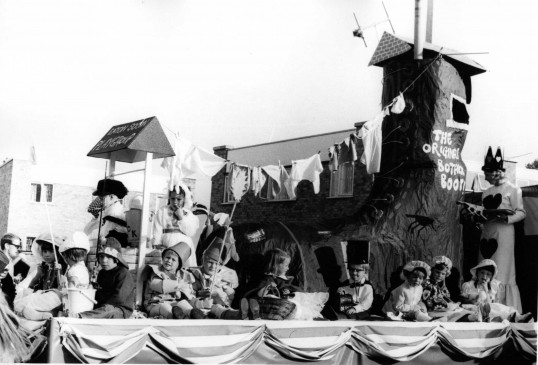
The story I have to share is from my time at school. I remember taking part in St Neots Carnival with my class. Here I am on Mrs Terry’s Playgroup float in 1969. It was great fun making the old boot, getting dressed up and then riding through the town on the float!

February festivals

If the cold, dark days are getting you down, then here’s a blog from our curator Liz to bring you a little cheer!

During the gloomiest days of the year, when spring and summer seem a long way into the future and Christmas and New Year celebrations a long way in the past, it is good to know that February is a short month with several celebrations to anticipate!

Candlemas

The month opens with Candlemas Day on 2nd February. This early Christian festival celebrates the day, when the Virgin Mary went to the temple to be cleansed after giving birth to Jesus, and to present her baby to God. In the medieval church a special mass service was held on the day, which was marked with a candle lit procession, hence the name ‘Candlemas’.

Badgers take centre stage

February Festivals - European Badger

European Badger

February 2nd also marks the midpoint of winter, between the shortest day on 21st December and the spring equinox on 20th March, and this perhaps suggests the ancient farming roots of festivities on the day. It was also a day when traditionally the weather for the rest of the winter could be predicted. Cold and bright weather on the day was said to foretell a cold end to the winter, while mild and wet weather was said to predict a gentler transition into spring.

An alternative name for the day was ‘Badgers’ Day’, as it was believed in some parts of Huntingdonshire (and more widely across Europe) that badgers would wake up on that day, go to the entrance of their sett (burrow) and their actions would predict the weather ahead. If it was sunny, and they could see the shadow of their tail on the ground, then they would go back to sleep as it was a sure sign more cold weather was coming.  When Europeans emigrated to America from the later 1600s they took this belief with them. Then, observing that the behaviour of the North American groundhog was similar to that of the European badger, there the 2nd February became known as Groundhog Day.

February Festivals - Pancake Day

Quads at Pancake Day, 1940

Pancakes and penitence

February is also the month in the Christian calendar when Lent begins. This is the period of denial and fasting which begins with Shrove Tuesday, marking the lead up to Easter. Of course Shrove Tuesday is also known as Pancake Day when everyone uses up their milk, eggs and flour ready for fasting in Lent.  In St Neots, the day was marked by the ringing of the pancake bell from the parish church, which continued until 1914. It is obviously no accident that Lent used to coincide with a period when food supplies from the previous year’s harvest might be running low, and so for many people there would be less to eat in February.

February Festivals - Rural traditions

Local haymaking, 1930s

Like Candlemas, Shrove Tuesday (when you were ‘shriven’ or absolved of your sins) has its roots in ancient farming and fertility rituals. In the Roman calendar the festival of Lupercalia was held in mid-February to drive off evil spirits and purify the land, bringing health and fertility in the coming year.

Love is in the air

Also celebrated during February is St Valentine’s Day. The day is said to commemorate the martyrdom of a Roman Christian called Valentine on the 14th February AD269, but how this event became a day celebrating true love is unclear! Perhaps this is another case of an ancient rural tradition – one that states that birds would choose their mate on this day – being given a new Christian meaning by the early Christian church.  Whatever the truth of its origins, Valentine’s Day (and the associated sweet treats to go with it) is now another festival to look forward to in February.

And as for the second half of the month? Well, you’ll just have to hold on to the thought that Spring is just around the corner…

A history of time – the story behind our days, weeks, and months

Who do we have to thank for our divisions of time? And how did the days and months get their names? Read on to find out in our brief history of time…

We’ve been thinking a lot about time recently. It’d be fair to say that the days, weeks, and months of the past year have lost a little of their definition, with current restrictions causing the passage of time and normal routine to become a little, shall we say, distorted. Time seems more fluid (though, on some days, the speed at which it seems to move feels A LOT slower), and it reminds us that our units of measuring its passing haven’t always been in place…

Dividing the days

As with many things, we have the ancient Babylonians to thank for our 24-hour days. They were the first to divide both the day and night into 12 equal hours, later separating each hour into 60 minutes and the minutes into 60 seconds. Though these divisions of time were based on the movements of the Sun and Earth, they also had their roots in the Babylonians’ numbering system – and here’s where it gets mathematical!

An early counting method using the digits on a single hand

Unlike our standard decimal system today based around grouping numbers in ‘10s’, the Babylonians used duodecimal (base 12) and sexagesimal (base 60) numeral systems – systems that were in fact started by the Sumerians, a culture that began 2,000 years before the Babylonians, in around 4000BCE. It’s believed the system likely originated from ancient peoples using their thumbs as a pointer, and counting by using the three jointed parts on the other four fingers (try it yourself!) It was pretty logical, then, for them to divide their time using this same mathematical system.

(If you want to fall down the rabbit-hole of information on this, here’s a pretty good starting point!) 

Days become weeks, weeks become months…

When it comes to the number of days in a week, and weeks in a month, it seems we have the Babylonians to thank again. For them, the number ‘7’ held a particular significance, observing as keen astronomers, that there were seven celestial bodies in sky – the Sun, the Moon, Mercury, Venus, Mars, Jupiter and Saturn. Through their lunar calendar, which tracked the transitional phases of the moon, they also calculated that it took approximately 28 or 29 days for the moon to complete its full lunar cycle. This period (give or take a few ‘transitional’ days) became a ‘month’, and, divided into four equal parts, produced seven-day ‘weeks’.

Fragment of a Babylonian celestial calendar

Though other great civilizations chose to divide their weeks slightly differently – the Egyptians’ week was 10 days long and the Romans’ originally lasted for eight – it was the Babylonians’ system, born from such an influential culture, that lasted, spreading quickly through the neighbouring large empires of Persia and Greece.

(N.B. How the modern year came to be divided into 12 months is a more complex story, and the subject of another blog entirely! Later we’ll see that originally, the Romans chose to divide their calendar into 10 months, before necessity caused them to swap to 12)

It’s all in the name

So that’s the maths out the way, now what about the origins of the names we now use for the days and months? Unsurprisingly, the names have their roots in astronomy and the deities that were once associated with the planets. It was our old friends the Babylonians once again who set the trend, naming each day after the celestial body they believed held sway over the first hour of that day. But it’s the Romans’ adaptation of the idea which led to the days and months being named as we know them today.

History of time - Sol gives his name to Sunday

Mosaic fragment of Sol Invictus

In the ‘romance languages’, like Italian and French, the days of the week have predominantly remained very close to their original Latin forebears. If we take the Italian, starting with our equivalent of ‘Monday’: Dies Lunae, the day of the moon, became Lunedi, combining lunae (moon) and di (day); Dies Martis, the day of Mars, became Martedi; Dies Mercurii, the day of Mercury, became Mercoledi; Dies Jovis, the day of Jupiter, became Giovedi; and Dies Veneris, the day of Venus, became Venerdi. Interestingly, Dies Saturni, day of Saturn, and Dies Solis, day of the Sun, are not the root for the modern Italian sabato (Saturday) and domenica (Sunday), though they clearly influence our English versions. Instead, the pagan names for these days were replaced and influenced by the Hebrew Sabbath, day of rest, and the Latin Dominus dies, day of the Lord.

Germanic adaptations

History of time - Tyr and Tuesday

Tyr equated with Mars in an 18thC Icelandic Manuscript (ÍB 299 4)

As for our English words for the days, we’ve seen they bear traces of the Roman, but it’s a connection that’s been heavily filtered through centuries of Norse and Anglo-Saxon influences. Like the Romans before them, Germanic people also adopted the system of identifying the days with deities, this time simply replacing the Roman gods with the names of their own. Monday derives from the Old English Mōnandæg and Norse Mandag, associated with Mani the Norse goddess of the Moon; Tuesday is associated with the Norse god Tyr, a warrior god like Mars, whose name in Old English gave us Tīwesdæg; Wednesday derives from Odin’s or Wōdensdæg, like the Roman god Mercury, Odin (Anglo-Saxon Wōden) played a part in guiding souls to the realms of the dead; Thor gave his name to Torsdæg or Thursday, sharing Jupiter’s association with the sky and thunder; Frigg, the Anglo-Saxon goddess of love, gives her name to Frīgedæg or Friday; strangely, Saturday retained its Roman deity, becoming Sæturnesdæg in Old English; and finally Sunday comes from the Old English Sunnandæg, deriving from the Norse sun goddess Sunna or Sól.

As for the months…

History of time - Januarius

January from the print series ‘The Months’ by Jacobus Harrewyn. Engraving, 1698. Held in the collection of The British Museum

The months are brought to us by the Romans again, who followed a similar naming method to the days to begin with, before, it seems, losing their creative flair as they approached the end of the year. Originally the Roman calendar began with March or Martius, named for one of their favourite deities Mars. Aprilis came next, named from the Latin word aperire, meaning ‘to open’, and sacred to goddess Venus. Maius (May) and Junius (June) were named for the goddesses Maia (a deity of springtime and growth) and Juno (the goddess of marriage and childbirth). When we reach July and August though, the calendar gets a reshuffle…

As we mentioned above, originally the Roman calendar (borrowed from the Greeks) had only 10 months, and as the fifth and sixth months of the year, July and August were once known as Quintilis and Sextilis. However, under the authority of Julius Caesar in 46BCE, two additional months were added to the year, in order to better synchronise the year with the seasons and tie in with the 12 lunar cycles of the moon. These were Januarius, named after the Roman god Janus (god of doors and beginnings) and Februarius, named after an ancient festival of purification known as Februa. At first, these two months formed the end of the year, but were later moved to the beginning (which explains the odd positioning of the leap year in the modern calendar). Quintilis and Sextilis, now out of order in the calendar, were renamed Julius (July) after Caesar himself, and Augustus (you guessed it, August) after his great-nephew and Rome’s first emperor Augustus.

History of time - Roman Maias

Maias from a Roman mosaic of the months (from El Djem, Tunisia, first half of 3rd century AD) Picture Credit: Ad Meskens

And as for the rest of the months? Well, here’s where the creativity runs out. September, October, November and December are also named after the Roman numbers 7 (septem), 8 (octo), 9 (novem) and 10 (decem). After January and February were moved to the beginning of the year, these too were placed out of order numerically. Though later emperors had a go at changing the names of the months (Caligula insisted that September be renamed Germanicus, after his father, and Nero had a go at renaming April Neronium), unsurprisingly, none of these stuck, and so the original names were kept.

So, if, like us, you’re struggling with the slow passage of time and uncertainties of the year ahead, take comfort in the knowledge that January, though it may be a bleak time of year, is named for the god of gateways and new beginnings. Time will pass, and whether you’re counting in days, weeks or months, lockdown too will pass.

The history of the rubber duck

It turns out there’s a national day for EVERYTHING, and the 13th January just so happens to be Rubber Duck Day! As we could all do with some light distraction, here’s a brief history of our beloved bath-time bud…

The earliest version of a ‘rubber duck’ first appeared in the late 1800s, when American chemist Charles Goodyear (later of tyre fame) invented vulcanised rubber – that’s rubber hardened via a process of heating with sulphur, making it pliable, mouldable and, most importantly, waterproof. Though, of course, the production of rubber toys wasn’t the original intended purpose of the process, they certainly turned out to be a happy bi-product!

The first ducks manufactured weren’t like the ducks we know today. For a start they were solid, weighty creatures which, unsurprisingly, didn’t float all that well (if at all!). In fact, the first rubber ducks were intended to be used a chew toys, for both babies and dogs alike, so you can imagine how unforgiving they might have been on tiny teeth!

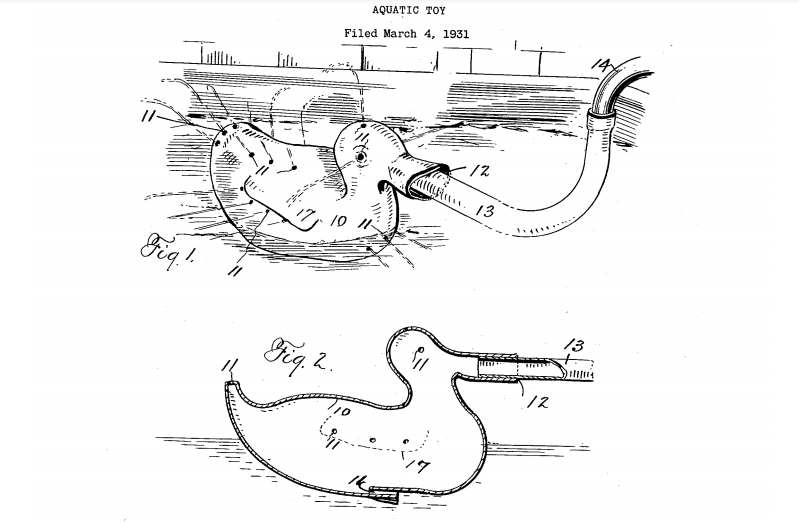
E. Shannahan’s patent for a duck aquatic toy, filed 1931, from the United States Patent and Trademark Office.

It wasn’t until the 1930s that the rubber duck’s association with bath-time began to materialise as a way of luring reluctant children into the tub for a much-needed scrub! Around this time, two separate duck bath toy products were developed, the first born from the mind of an inventor from Maryland, and the other from an unlikely collaboration between the Walt Disney Company and a latex manufacturer.

The first, invented in 1931 by Eleanor Shannahan of Maryland USA, was designed as an aquatic toy that could sit either above or below the surface of the bath, and would emit jets of water from the mouth and other small holes. In her own words, the toys would “produce a fountain like effect, and enable the playing of pranks by one person on another by the squirting of a fine stream of spray upon the face or other parts of a person”.  You can even view the original patent for the toy here.

As for Disney, their collaboration with Seiberling Latex Products in 1938 enabled them to create ‘bath floater’ toys, of which the most popular pair were of course Donald and Donna Duck. (N.B. A bit of Disney trivia for you all, Donna Duck was later renamed Daisy Duck, first appearing as Daisy in the film Mr. Duck Steps Out in 1940).

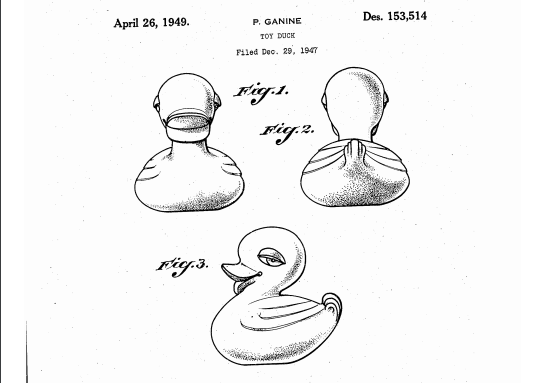
Images from P. Ganine’s patent for a toy duck, 1947, from the United States Patent and Trademark Office

Rubber ducks really hit the big time when in 1947, a sculptor called Peter Ganine filed a patent for a duck toy that he had created out of vinyl. Painted bright yellow and including their famous ‘squeaker’, the ducks were reproduced in their thousands and sold across the world. Then, in 1970, their fame grew to new heights when the song ‘Rubber Duckie’ was featured on Sesame Street, sung by everyone’s favourite character Ernie. The song was such a hit that it even made it to number 11 in the Billboard Charts in 1971!

Since then, rubber ducks have been making bath-time play-time for children (and grown-ups) around the world. Along with the iconic yellow and orange design, variants now exist in their hundreds, from every colour imaginable, to ducks masquerading as Romans and Vikings. The list goes on and on…

So, which rubber duckie is YOUR favourite?

St Neots’ sporting heroes

If you’re thinking of taking up a new sport or joining an exercise class this January, then you’ll be in good company! St Neots has a proud sporting heritage, much of which is celebrated in the museum with displays on some of the town’s sporting heroes…

Until the industrial revolution of the early 1800s, everyday life was strenuous enough to keep most working people fit.  Many local men were farm workers, and women’s lives, before the invention of the modern washing machine and vacuum cleaner, involved daily heavy labour. It was during the early Victorian period, as the population increased dramatically and people began to move away from the land and into towns, that organised team games for men (sadly there were very few organised women’s sports at that period!) began to become popular.

St Neots Rowing Club Eight in 1947

When the Reverend William Maule became the Rector of Eynesbury in 1851, a talented and experienced sportsman arrived in the town. Maule excelled at cricket and rowing, and while at Trinity College, Cambridge he’d been President of the Trinity Boat Club. By 1865 he had established St Neots Rowing Club which produced many fine rowers, including Laurie Evans, who was a member of many winning crews in the 1920s and 1930s.

As the enthusiasm for organised sports grew, many new clubs were formed in the town. St Neots Cricket Club, dating back to the 1840s, has had a chequered career, but other sports thrived. Cycling also took off as a sport in the late Victorian period, after Dunlop patented the pneumatic tyre in 1888, and the St Neots Cycling Club formed as early as 1887. An early champion of the club was E. J. Bass of Eynesbury who was a rider of national importance. The photograph below is thought to show him in 1899 after he had won the mile race at the Spring meeting of the Surrey Cycling Club, held at the Kennington Oval (one of the most important meetings of the cycling calendar). The First Prize of a silver claret jug and silver beakers can be seen in the photograph.

E.J Bass, 1899

Another talented sportsman who threw himself into the sporting life of the town was C.G. Tebbutt, who moved to the town from Bluntisham in 1889. Not only was he a gifted skater and ice hockey (bandy) player, he was also an outstanding speed skater holding three world speed skating records in 1891. At different times in the 1890s, Tebbutt captained both the St Neots football club and the cricket club.

Champion jockey Otto Madden was also educated at the Eaton Socon Academy, Peppercorns Lane in the 1880s.  He was the most successful British jockey between 1888 and 1918, and Champion Jockey in 1898, 1901 and 1903.

Women were also keen sports players, but found it much harder to break into the world of organised sports. However, Eaton Socon Ladies’ Hockey Club formed in late 1898, and already by 1894, St Neots Golf Club (founded 1890) was holding a Ladies Monthly Prize competition, with a final in the April of the following year.

St Neots & District Football Club, 1925

Football became an increasingly important part of national life in the 1950s and 1960s, several local boys became professional players, including Chris Turner, Terry Oakley and Christopher Jones. The most well-known of our local footballing hero’s was John Gregory of Longsands school, who played for England in the 1983 – 84 season and later went on to a successful career as a team coach and manager.

As the opportunities for ice hockey declined with warmer winters, and with the development of the Little Barford Power Station upstream of St Neots Common, field hockey became a popular sport, with the St Neots club boasting teams of both men and women players. The town’s moment of glory in the hockey world came when local player, Anthony Ekins, was selected to play for both England and Great Britain between 1966 and 1972. He played for Great Britain in the 1968 Mexico Olympics and captained the British team at the Munich Olympics in 1972. More recently, the triumph of the GB women’s hockey team, who took Gold at the 2016 Rio Olympics, has made hockey the fastest growing participation sport in the UK.

Hockey match with Tony Ekins on far right, about1970

Many other sports flourished in the post war period. Philip Cole played table tennis at county level and was National Student Table Tennis Champion in 1982. The St Neots Outdoor Bowls Club was formed in 1920, and member Joyce Brittain, nėe Hodson, was a very talented outdoor and indoor bowls player. She reigned as the Cambridgeshire Ladies Singles Champion for most of the 1950s, and played outdoor bowls for England to International level in 1961 – 63. Her son, Roger Brittain, was also an excellent bowls player at both club and county level.

Finally, in the twenty-first century running has become an increasingly popular sport, with thousands of people taking to the pavements. The St Neots Riverside Runners were established in 1987 and remain a very successful club, organising many local runs including the Riverside 10K run and the St Neots Half Marathon.

It’s impossible to cover everything in this brief article, so if you have any information and / or photographs about local sports that you would like to pass on to St Neots Museum, please do contact the Director via email at director@stneotsmuseum.org.uk. Photographs can be copied and returned.