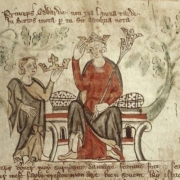
Edward II & monarchs who met a nasty end!
Historical legend tells us that on the 21st September 1327, King Edward II was brutally murdered at Berkeley Castle, by receiving a red-hot poker to the bottom, yikes!
Though the story may merely be fable (theories from historians differ as to the method of his murder, or indeed whether he was murdered at all!), we thought we’d recount the circumstances of his death, and take look at three other nasty ways historical monarchs supposedly met their end…
A brief round-up of his reign
Strong-leadership and ruling capability were sadly two key qualities that Edward II of England lacked. Within the first few years of his reign, he’d angered the powerful barons of England by gifting high offices to his father’s (Edward I) opponents, and to his own favourites; most notably his close friend (and supposed lover) Piers Gaveston. This poor decision making in the eyes of the barons, led to a series of Ordinances put in place against the king, restricting his powers and banishing his favourites into exile. If this wasn’t bad enough, the barons also blamed Edward for gifting Scotland its independence from England, after he lost badly to Robert the Bruce at the Battle of Bannockburn in 1314. On top of that, his tumultuous relationship with his wife, Isabella of France, resulted in her invading Britain from France in 1326 with her exiled lover, Roger Mortimer (another powerful opponent to the king). This led ultimately to Edward’s deposition as king and imprisonment in 1327. Phew, are you keeping up?
A gruesome death?

Berkeley Castle, Gloucestershire
Edward was imprisoned for many months, constantly moved from prison to prison to keep him out of reach of supporters who would free him. He was placed in permanent captivity at Berkeley Castle in the summer of 1327, where legend tells us he was brutally murdered by a red-hot poker inserted into his rear – the method suggested to be in reference to his supposed homosexual relations with his past favourite, Gaveston. Whether this was his actual fate or not, Edward was not heard from again after this date. Most historians believe that he did indeed die at the castle by some means or other, his demise simplifying the political situation for his captors. However, the rumours of this method of death only began to circulate after the execution of his rival Roger Mortimer in 1330, likely as deliberate propaganda spread against Mortimer’s faction. Whether Edward did indeed meet with such a grisly fate, then, remains a mystery.

Edmund Ironside, Royal MS, 14B.VI
Edmund Ironside
Another monarch who supposedly met a similar fate to Edward was Edmund Ironside, who ruled England briefly in 1016AD. He’d been forced to divide the ruler-ship of England with the Danish King Cnut after losing to him in battle. The terms of this agreement stipulated that it would remain in force until the death of one of the participants, at which time all lands would revert to the survivor. A term that was just asking for trouble!
According to Henry of Huntingdon, and other royal sources, Edmund was staying at the house of Eadric Streona of Mercia, the duke who had cost him his defeat to Cnut by fleeing the battle field. When Edmund got up in the night “to do the duty of nature”, Eadric’s son, hiding in the pit beneath the toilet seat, reportedly “pierced the king among his private parts twice with a sharp dagger”. Nasty! Though Cnut was not implicated directly in the assassination, it was suggested that he might just have had a hand in Edmund’s unfortunate demise.
Henry I

Lamprey, with those teeth!
Henry I, who granted important royal privileges to St Neots priory in the 12th century, was the youngest son of William the Conqueror, and ruled England from 1100-1135AD. He had a fairly successful reign, achieving domestic peace in England, as well as English territories in Normandy. In 1135, despite ill-health, the ageing Henry took a trip to Normandy to see his two grandsons. Once there he fell iller still, and according to ‘trusty’ chronicler Henry of Huntingdon, once again, died from a terrible case of food poising after over indulging in “a surfeit of” lampreys, which his doctors had forbidden him to eat. We don’t blame them, have you ever seen a lamprey? Yikes!

Parade armour of Henry II, held in the Met Museum
Henry II of France
Henry II was a keen hunter and jouster, both notoriously dangerous sports! In June 1559 a tournament was held in Paris to celebrate a peace treaty between France and Spain, and King Henry entered the lists. Halfway through the tournament it was reported that Henry had started suffering dizziness after his physical efforts, and was almost unseated from him horse in a jousting match against the Count of Montgomery. After this, his wife, Queen Catherine de Medici, tried to persuade the king to call it a day, but Henry was having none of it, and insisted on another contest with Montgomery. This time, Montgomery’s lance struck the king’s helmet, and a long splinter pierced Henry’s eye and penetrated his brain *winces*. Bleeding and almost unconscious, Henry was carried back to his royal apartments, where surgeons removed the splinters from his head and neck. Amazingly Henry survived in an unconscious state until the 9th July, when he passed away with Queen Catherine at his bedside.