The history of biscuits

Munchable, scoffable, dunkable, WONDERFUL biscuits – few things in life are more pleasurable than a mug of tea and your favourite biccy.

It just so happens that the 29th May is officially National Biscuit Day! So, we thought we’d have a brief look at the history of these delicious treats. If you make it to the end of this without a craving for one, then your willpower truly is iron clad…

In the beginning…

House of the Baker, Pompeii

It turns out that biscuits, in some form or other, have been around for a really REALLY long time! The name ‘biscuit’ comes from the French ‘bis-qui’, but it’s Latin root ‘panis biscotus’ (meaning twice-cooked bread), tells us a variant of the treat has been around since at least the Roman period.

The biscuit the Romans had is closer to a ‘rusk’, the sort that babies today now enjoy, and was basically bread which had been baked again to make it crispy. In this form, the bread kept for longer and was often used as a snack for those ‘on the go’ or as part of a centurion’s’ rations. Jumping ahead of ourselves here, we see biscuits being used in this way much later in the 18th, 19th and even 20th centuries too as part of ships’ rations. Unable to maintain a constant supply of fresh food, naval boats would carry huge supplies of ‘ship’s biscuits’ or ‘hardtacks’, biscuits so tough they were famous for being indestructible. Unsurprising then, that the earliest surviving example we have of a biscuit from 1784, is one such biscuit!

Medieval and Tudor treats

‘Biscuit’ came to use in English from around the 14th century, and variations on the theme started to appear. Varieties closer in form to pancakes were also becoming more common. Wafer biscuits started to emerge and grew in popularity, these were made of a sweetened batter and cooked over a fire. The famous ‘Jumble Biscuit’ also appeared in the Medieval period, traditionally shaped in a knot pattern and flavoured with much prized spices like caraway, aniseed and mace.

By the Tudor period gingerbread had started to appear. Containing sugar and expensive spices, it was only for the rich (and those who weren’t too bothered about their teeth!) The gingerbread was often coloured and moulded into intricate shapes and structures. The first ‘gingerbread-men’ are often attributed to court of Queen Elizabeth I, where biscuits were made in the likeness of important guests. Fancy!

The darker side to our sugar craving

Biscuits started to become more accessible to the masses in the 17th century due to the colonisation of the West Indies and Americas, and the rise of the slave trade. This dark and shameful chapter of our history caused the price of sugar to fall dramatically, which in turn sparked new developments in the types of biscuits and cakes on the market. Chocolate, coffee and tea were also introduced to Britain at this time, and were soon to become the popular partners to biscuits. Until the 18th century, biscuits had mainly been eaten as a dessert, but as drinking tea became rooted in our society, biscuits became tea’s ideal accompaniment.

A biscuit revolution

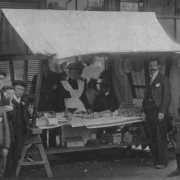
Biscuit and cake stall, St Neots Market, c. 1900

By the 19th century, biscuits had really taken off, and the varieties available had increased substantially. The Industrial Revolution allowed biscuits to be produced on mass, and changes to the working day caused breakfast to be eaten earlier and dinner later, leading to an increase in the need for an afternoon snack! Big names such as Peak Freans started the production of Garibaldis in 1861, and Bourbon biscuits in 1910.  Digestive biscuits were developed by Huntley & Palmers in 1860, and marketed as, you guessed it, an aid for digestion.  In 1892 McVities made the first Rich Tea biscuit, and followed it up with the Chocolate Digestive in 1899. Many biscuit companies produced special tins of their biscuits, which quickly became the new must have collectable items.

Plum’s Cake Shop & Cafe St Neots, c. 1920s

And today…

Today, the biscuit industry is worth over £3 billion and recent studies have shown that 99 in every 100 UK households buy biscuits. From the humble Digestive, to the dunkable Hobnob, to the flamboyant Party Ring, it’s fair to say our love of biscuits shows little sign of diminishing.

So, which is your favourite?…
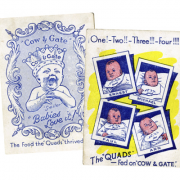


Toddler Time – St Neots Quads

What time is it? It’s Toddler Time! This edition is all about the St Neots Quads. Join Lesley as she tells us all about the famous quads, reads us a lovely story, and gives us a great crafting activity to do at home. Just click here to download the Quads Paper Chain template.

When this film was made, all the Quads were still alive. Sadly, two have since died in November 2025

The history of English gardens

Here’s a fascinating guest post by one of our volunteers, Emily, who’s here to enlighten us all about the history of our beloved gardens…

Gardens, we all take them for granted these days don’t we? Whether it’s a little plot at the back of your house, or a ginormous plot of land belonging to a large estate, the garden is a place where we can retreat and where nature can thrive. But have you ever thought about the origins of our gardens, and how they evolved over the centuries? Well, if you are sitting comfortably, then I’ll begin…

Tudor garden twists

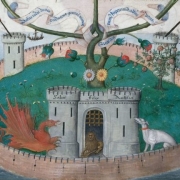
A Tudor maze design

Gardens in the past changed with what was fashionable at the time. If you didn’t have the latest garden trend, then you were nobody. In the early days of the Tudor period, gardens were, like today, places to socialise and to take exercise. In those days, when practising the wrong religion could get you into BIG trouble, rich landowners would hide religious symbols within their gardens, as well their houses. A maze was often a feature in these gardens, and guest could enjoy them often oblivious to the notion that they may be a religious symbol. Instead what they saw was perhaps a form of entertainment, especially when catch a dashing suitors’ attention was part of the fun!

By the time of the Stuarts, some considered the style and symbols of the old Tudor gardens, ahem, out of date, and had them redesigned to meet the fashionable standards of the time. Trees and paths were the order of the day! Oh there were flowers too, but planted in straight lines. The English were very keen to stay ahead of their rivals, the French, and it was very much a case of “anything you can do, we can do better ”. So English gardens became very French in style, in an attempt to out do them. An example of this is the famous garden at Hampton Court. A garden for royalty and the well to do, designed for walks and parties. A bit like today really!

The illusion of untamed nature

Fast forward to the Age of Enlightenment and the gardens of the stately home changed dramatically. Out went the formality and in came the ‘nature-controlled’ gardens, ones created by man, but with the illusion that they were perfectly natural. We see this most in the gardens of the stately homes we know and visit today, from Stowe in Buckinghamshire to Castle Howard in Yorkshire. Like the Tudor gardens, these could also have hidden meanings. From the political views of the owner, to telling stories according to folklore and fairy tale, the garden became a place for the well-to-do to play out their fantasies.

Cambridge Botanical Gardens – Photo copyright Emily Fleming 2020

These gardens didn’t come cheap though, if you were hoping to build a grotto for your back garden for a small sum, you’d need to think again! One man responsible for making these gardens a reality was Lancelot “Capability” Brown – THE man for job. The prices attached to his gardens were eye-wateringly expensive, particularly as everything was done by hand, no JCBs here! Planning a visit to your local garden centre to buy things off the shelf wasn’t an option, and much of it, like the statues, had to be sculpted from scratch.

BUT if you DID have the cash, then you could have everything you could possibly want. Waterfalls, temples, grottos, you name it. The temples and ruins that were constructed for these gardens were often Grand Tour inspired. These trips or ‘tours’ were taken by the aristocracy to places like Greece and Italy, and from them, they bought back classical ideas for their gardens. It was the time of ‘the Romantics’, romanticising the ancient histories of Rome & Greece. It’s something we still do today, we all like a bit history in our gardens…

Kitchen gardens

In the Georgian and Victorian periods, the garden changed again, with clashing colours mixing in the borders, and the introduction of greenhouses for growing plants and produce normally grown in a warmer climates, like ferns and palm trees! Growing fruit and veg in the garden had of course been around for some time, with many stately homes having their own kitchen gardens built for the purpose. Back in the Georgian period, the way to show off your wealth was to have a ‘pinery’ for growing, wait for it, pineapples! Why were they a symbol of wealth you ask? Because pineapples are notoriously temperamental and an absolute pain to grow!

The humble back garden

Photo copyright Emily Fleming 2020

By the Victorian era, the garden started to become more accessible to the masses, and those who were lucky enough to have their own back garden for their property, used them primarily to grow produce for their families. Gardens became more functional places over spaces to socialise. During WW1 and WW2 the kitchen garden was considered more important than ever before, growing whatever was needed to survive.

Today, many gardens combine the role of food provider and leisure space, taking snippets of inspiration from gardens throughout history and all over the world.  Whether they are well loved and cared for or messy, neglected and in need of a little love, they’re something that we all recognise and take pleasure from. The fashions and designs of gardens will change, but the need and desire for them will always remain the same.


Curator’s Corner – Victorian Criminals

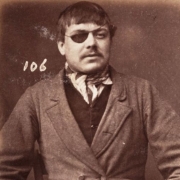
This time, Liz talks crime and punishment in Victorian St Neots. We meet some of the local people accused of minor crimes, and find out what penalties lay in store for them…

Unfortunate royal epithets

Ever wondered about the stories behind historical monarchs’ epithets? Here’s 10 royals from the past who gained some rather unfortunate nicknames…

It’s tradition for monarchs the world over to gain a few additional names, both during and after their reigns. For some, these might be good or heroic e.g. William the Conqueror or Elizabeth Gloriana; for others they might be more mundane. Both Henry I and Henry II, who granted important privileges to St Neots priory in the 12thC, had epithets of a less exciting nature (Henry I was known as ‘Beauclerc’, the French for ‘Good Clerk’, and Henry II gained the name ‘Curtmantle’, Middle English for ‘short cloak’).

Unfortunately for a large number of royals, the nicknames associated with them are of a more, shall we say, unflattering tone. We’ve picked our top 10 below, revealing the story behind the name…

Ethelred the Unready

Two Anglo-Saxon silver pennies of Aethelred held by the museum

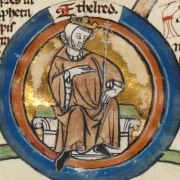
Let’s start with a famous one! Ethelred (or Aethelred) the Unready, was king of the England from 978-1013CE and again from 1014-1016CE. He is famous for being an incompetent ruler, who failed to prevent the Vikings from overrunning England. He first attempted to buy his way to peace, but when this failed, he launched attacks on the Danish settlers, only provoking further invasions! The epithet ‘unready’ is derived from ‘unraed’, which actually means ‘bad counsel’ or ‘no council’. The nickname is in fact a twist on his name which rather comically means ‘noble counsel’.

Ivar the Boneless

Ivar the Boneless was a Viking leader who invaded Anglo-Saxon England in the 9thC, becoming ruler of York. The origin of the nickname is up for debate; several of the Viking sagas alarmingly describe him as lacking legs or bones, whilst in the ‘Tale of Ragnar’s Sons’, it’s suggested that his name is in fact figurative, and refers to male impotence!

According to the ‘Tale of Ragnar Lodbrok’ (Ivar’s father), his bonelessness was the result of a curse. His mother Aslaug, a seeress, prophesied that she and Ragnar needed to wait three nights before consummating their marriage. But Ragnar, overcome with lust after a long separation whilst raiding England, ignored this advice. As a result, Ivar was born with weak bones.

Ivaylo the Cabbage

Slightly more surreal in the name-game is Ivaylo of Bulgaria. Ivaylo is remembered as a strong military leader, spearheading numerous peasant uprisings before climbing up the social ranks and eventually becoming emperor. His nickname ‘the cabbage’ or ‘lettuce’ was given to him to reflect his low social origin. Charming!

Louis the Unavoidable

Poor old Louis XVIII of France spent much of his reign in the late 18thC in exile due to the French Revolution of 1789-1799. When things began to stabilise once again at the turn of the 19thC, and Napoleon was finally defeated in 1815, Louis was deemed the ‘unavoidable’ choice to return and reclaim the throne. Talk about a blow to his self-esteem!

Joanna the Mad

The impact of a grief filled life earned poor Joanna of Castile this unfortunate name. Big sis to Catherine of Aragon, and sister-in-law to Henry VIII, Joanna was also married to Philip ‘the handsome’ of Spain (lucky her!) In her early life she was an intelligent and well-educated young woman, with numerous languages under her belt. However, after the deaths of numerous family members, she suffered from long bouts of insomnia and poor appetite, and was often known to fly into a rage when prevented from exercising her will.

But the act that really sealed her as ‘mad’ in the minds of the people, happened when her husband died in 1506. Joanna refused to part with her husband’s body for a disturbingly long time. Though she was heavily pregnant, she travelled with his body from Burgos to Granada (just shy of 670 kilometres!), where he was to be buried. She was said to have often opened her husband’s casket on route, to embrace him. Eep!

Charles the Mad

Staying along the same lines, the French King Charles VI was known to have suffered from multiple spells of real insanity during his life time. We’re told that at times he couldn’t remember who he was, nor did he recognise his wife or children. He would often ‘run wildly’ through the corridors of his palace, compelling his staff to have entrances walled up to prevent him from escaping! The thing that Charles is most famous for, however, was the belief that he was made of glass and could shatter at any time, he even had iron rods sewn into his clothes to stop himself from breaking…

Bloody Queen Mary

Mary I of England spent only five years on the throne, but during that time she gained quite a reputation for herself. She is famous for her persecution of her protestant subjects, burning them at the stake (the preferred method of execution by the notorious Spanish Inquisition) in an effort to return the country to Catholicism. In actual fact, she was responsible for far fewer deaths than her father Henry VIII, but later propaganda during her protestant sister Elizabeth I’s reign, muddied her name and magnified her acts of oppression.

Mary had been married to Phillip II Spain, who had attempted to use the union to exercise his own influence over England. After Mary’s death, Philip sent a fleet of ships (the famous Spanish Armada) in an attempt to take control, but was defeated by the English navy. Mary was seen as the catalyst for this renewed threat from Spain and was therefore blamed for the whole sorry matter. That bloody Queen Mary, eh?

Louis the Spider

This one depends on how you feel about spiders really… King Louis XI of France had a love of plotting and intrigue, he had a history of planning and participating in conspiracy, even against his own father Charles VII. After he ascended to the kingship in 1461, his love of scheming continued, he had a network of royal postal roads developed, with messengers at his constant disposal to aid in his intrigues. He earned the names ‘Cunning’ and the ‘Universal Spider’ due to these communication ‘webs’, along with the webs of conspiracy he would spin around Europe.

Harald the Lousy

Sticking with the creepy-crawly theme… Harald Harfagre was the first King of Norway in the 9thC. His byname, ‘Harfagre’ actually means ‘fair haired’ or ‘beautiful haired’, but according to historical sources this wasn’t always the case…

Legend tells us that Harald had previously vowed not to cut his hair until he was the king of Norway. By the time he actually received the crown a decade later, his hair was understandably in quite a state, and home to a fair few skin-itching hitchhikers! It’s no wonder he chose to re-brand after becoming king…

Charles ‘the Bad’ of Navarre

What better place to end than downright bad? Charles’ career was littered with rebellion and assassinations as he fought to gain power from John II, King of France. In his attempt to gain the crown, he even allied himself with the English King Edward III, the ultimate betrayal! But the act that really earnt him the title ‘bad’ was his involvement in the ruthless suppression of the Jacquerie (French peasant) revolt in 1358, where men were slaughtered in their thousands.

Charles was to get his comeuppance however, and his horrific death in 1387 became famous throughout Europe as a divine justice. After Charles became ill, his doctor ordered him to be wrapped head-to-toe in brandy-soaked cloths. When the nurse administering the wrapping had finished, instead of using scissors to cut off the excess fabric, she used a candle to burn off the end. And you can guess what happened next…

Charles the Bad and John the Good

World War II Memorial Paintings

A selection of works inspired by WWI and WWII by artist Richard Walker. Together, they form part of a large painted chapel that will be housed in a purpose built space in the new Museum of Military Medicine in Cardiff.